

PROFESSIONAL TRAINING ⌖ LIVE LECTURE SERIES
The Live Edge in
Autonomic Physiology
A Renaissance in understanding the Living ANS
This is a 3-hour zoom course designed to rapidly bring you up to speed on the Autonomics model. Over the past several years we have published a new foundation model of autonomic physiology that goes back to first principles.
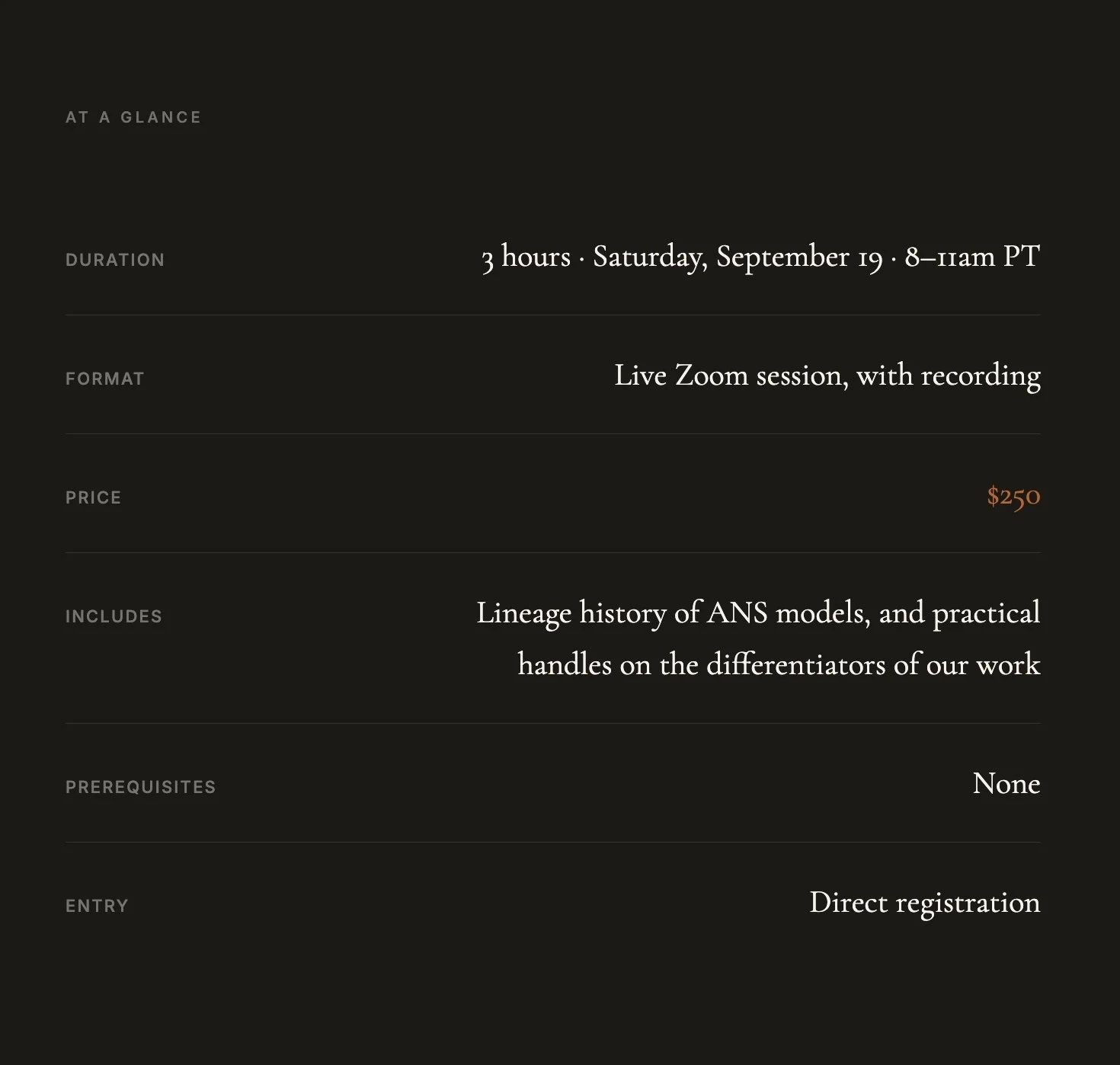
Saturday September 19. Every registrant receives access to the live lecture and its recording.
ALSO THE ENTRY POINT FOR
The Florentine Lectures in Autonomic Physiology
Where the field is moving.
Saturday, September 19, 2026
The Live Edge in Autonomic Physiology
This is a 3-hour zoom course designed to rapidly bring you up to speed on the Autonomics model. Over the past several years we have published a new foundation model of autonomic physiology that goes back to first principles.
It re-architects the neuroanatomical boundaries of the primary autonomic systems, differentiates neurology from neurochemistry, and builds a three-variable model of autonomic state that has much greater nuance and descriptive specification (both qualitatively and quantitatively) than any extant model.
In this 3-hour Zoom session I will explicitly differentiate our work from Polyvagal Theory, which you will find interesting not merely pedagogically but because I worked closely with Dr. Stephen Porges for a number of years (authoring and art directing the only authorized complete visual depiction of his work) and have been very publicly active in the Polyvagal controversy that began last January when Paul Grossman published the untenability paper. You can read my new essay about it in the Psychotherapy Networker here.
I will also briefly seed some of the themes were going to dive deeper into later this fall in the Florentine Lecture series, including a brief look at predictive coding and Bayesian inference.
Among other things, this training will give you a much deeper experiential understanding of why I regularly say that the autonomic nervous system is not a ladder and why I say that the sympathetic nervous system does not exist. The clinical reality of autonomic state is a 3-variable reality, and this has fundamental implications for how we understand our own experience, and how we view others through an autonomic lens.
FORMAT
What to expect.
A working session in current autonomic neurophysiology, built for practitioners who want to stay current — whether or not they have prior training in the Autonomics model.
No prior Autonomics training required. Foundational terms are introduced as they're used.
Three hours, live on Zoom, September 19.
A recording is included for every registrant.
TESTIMONIALS
Reserve your seat for September 19, 2026 – live on Zoom.
All four seminars, plus the February synthesis session — available only to season pass holders. Live attendance and a recording of each session.
PROGRAM STRUCTURE
Get your lecture series pass for the Florentine Lectures.
The September 19 training is a an opportunity for us to bring people up to speed on the Autonomic model before we kick off a 4-part deep-dive lecture series: The Florentine Lectures in Autonomic Physiology: a series of expert-level trainings at the living edge of our research, on Zoom monthly. Available as a series of Saturday lectures with a culminating synthesis session, or as individual lectures.
First lecture October 10. Every registrant receives access to the live lecture and its recording.
FULL SERIES ⌖ RECOMMENDED
One lecture (subject to availability). Live presentation and access to the recording.
INDIVIDUAL TICKETS ⌖ ONE-AT-A-TIME
The Live Edge in
Autonomic Physiology
-
Autonomics is an accurate foundation model of the ANS in its living functionality — a neural cartography and a methodology for working with the deepest levers governing moment-to-moment human wellbeing, made sensible for diagnosis (we can feel them), and tractable for intervention (we can change them).
A pattern language observed in 5,000 people from 50 countries, with clinical and research contributions from more than 100 advisors from 25 healing traditions in 24 cultures.
-
The entire received history of neuroscience is based on necrotic anatomy. For the same reason that if we wanted to teach you about the forest we would not take you to a lumberyard, our work returns to first principles to re-map the living architecture and dynamics of these systems.
-
Come rapidly up to speed in Autonomics. We will trace the evolution from a two-variable (seesaw) model of the ANS, to a three-variable heirarchy (Polyvagal Theory), to a nine-variable model (Autonomics).