
PROFESSIONAL TRAINING ⌖ DEEPEST ENGAGEMENT
Yearlong
Autonomics
Practicum
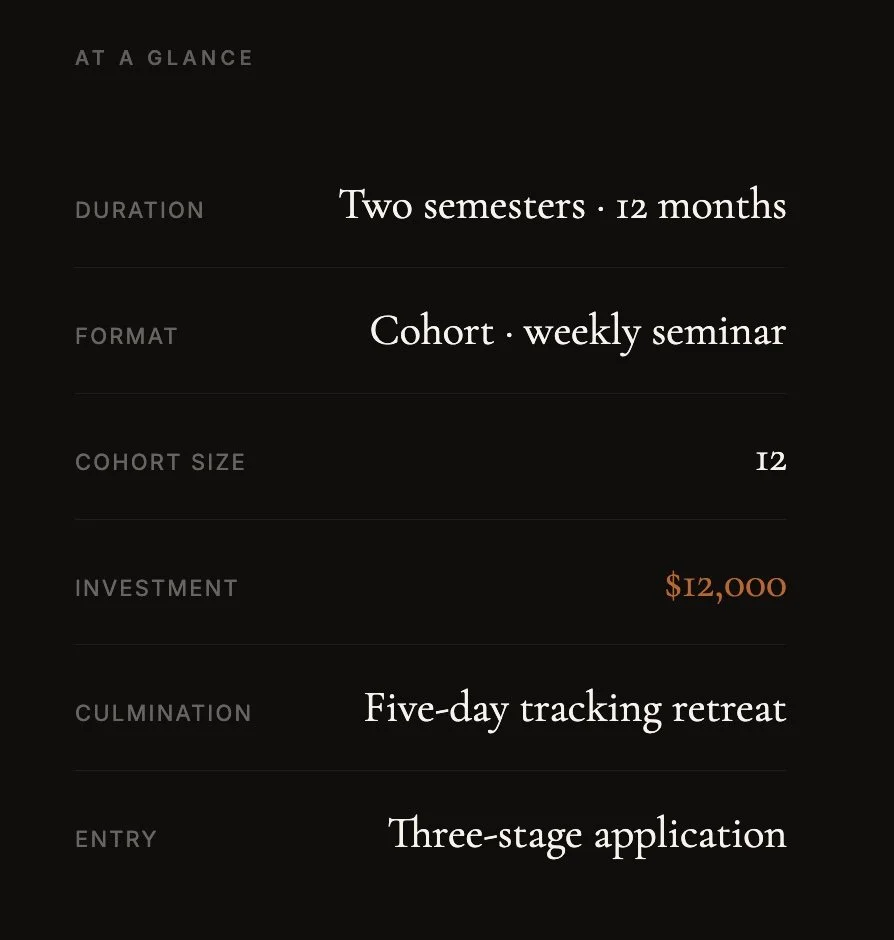
A year-long academic & practitioner training program organized as a cohort of twelve meeting weekly in seminar. The model is a guild, not a curriculum. What is being developed here is a craft: the art and science of working with the living ANS.
The Practicum, Explained
A six-minute introduction from the Founder of Hearth Science
The practicum is the foundational training in Autonomics. It follows a guild model rather than a curriculum model — clinical competence in this work does not reduce to a sequence of steps and is not achieved by completing a checklist.
The program produces practitioners capable of tracking the living autonomic nervous system in another person with precision, in real time, and responding to what they observe. That is what a year of this work is designed to build.
The cohort meets weekly in seminar throughout the year. Two semesters structure the arc: the first focuses on autonomic cartography and transformational work on your own autonomic baselines. The second moves into autonomic tracking in earnest, building on that foundation.
The year culminates in a five-day tracking retreat where clinical competence is evaluated by faculty. There are objective quality standards for successful completion.
WHAT THE PRACTICUM IS
A craft not a checklist.
WHAT COMPETENCE REQUIRES
Four capacities form the foundation.
-
A precise and in-depth command of the three variables (context, neurology, and neurochemistry) that comprise the three-system framework — its anatomy, its diagnostic structure, and the pattern language that makes the living ANS readable in a clinical encounter.
-
A fundamental transformation of your own autonomic baselines, such that your nervous system can function as a clear instrument. You cannot track someone else clearly if you are not clear.
-
The ability to track moment-to-moment changes in another person's nervous system with fidelity — to feel what is happening in their ANS as it shifts, not after the fact.
-
A developed fluency with the pattern language of autonomic phenomena sufficient to read what is happening as it shifts — and to know what that reading calls for clinically.
Prior training and practice that transfers well into this work includes embodied movement and somatic practices of any kind, mindful and interoceptive awareness training, energy practices, yoga, tai chi, and qigong.
These are not requirements. They are backgrounds that tend to give practitioners a head start on the first semester's work — because the capacity being built in that semester is one they have already begun developing.
One background is unusually applicable — and rare among wellness practitioners: deep nature awareness and hard ground tracking. If this is part of your practice, it is directly relevant to the diagnostic methodology at the center of this work.
Clinical licensure is not a requirement. The practicum is open to practitioners across modalities whose work takes them into contact with the autonomic nervous system — whether or not their training named it that way.
PRIOR TRAINING
What transfers well into this work.
The first semester is focused on autonomic cartography and transformational work on your own autonomic baselines. This is the prerequisite for everything that follows.
You cannot track the ANS in another person with precision until your own nervous system has been reorganized enough to function as a reliable instrument. That reorganization is what this semester is designed to produce.
By the end of the first semester, participants have a working command of the three-system framework and a meaningfully transformed relationship to their own autonomic landscape.
SEMESTER TWO ⌖ AUTONOMIC TRACKING
The second semester moves into autonomic tracking — learning to read the living ANS in another person in real time. This is where personal work done in the first semester pays off. (Aside from making your life better in every conceivable way ;)
Tracking is practiced within the cohort, in live clinical demonstrations, and in practice with peers outside the seminar. The feedback loop between theory, observation, and clinical experience is what produces fluency.
The year culminates in a five-day tracking retreat held each May or June, either at our Northern California headquarters or a retreat location in Europe. Faculty evaluation of tracking competence takes place on the final days of the retreat.
PROGRAM STRUCTURE
Two Semesters.
A complete arc.
SEMESTER ONE ⌖ AUTONOMIC CARTOGRAPHY
PROGRAM LOGISTICS
Weekly Time Engagement
You’ll be spending several hours in class with your cohort, an hour or two on homeplay (it is work, but…), and an hour or two in practice (in the Embodiment Lab, on your own, or with fellow participants). You might want to do some reading…
This will also depend a bit on your background. If you have no background in neuroanatomy, plan to spend more time memorizing structure, etc.
No background in interoceptive practice? You are going to want to practice this more…
Weekly Seminar
The primary container for the year. Two hours each week. Theory, demonstration, and direct practice within the cohort.
Embodiment Lab
A separate meeting focused on direct somatic and embodiment practice. Meets every other week throughout the year.
Homework
Primarily video-based assignments that carry the conceptual and observational work between seminar meetings. Relevant interviews, educational films, lectures, clinical session recordings…
5-day Capstone Retreat
The culmination of the year. Northern California and Europe. Faculty evaluation of tracking competence on the final days.
COHORTS
Cohorts begin each autumn.
Cohort size is twelve (plus faculty/ faculty-in-training). Composition is determined in part from our side.
TUESDAY MORNING COHORT - SEMINAR 7 TO 9 AM PACIFIC TIME
North America & Europe
Structured to be accessible to European participants. The morning time slot in North America falls in the afternoon for participants in Europe.
EVALUATION
Faculty evaluation
on the final days of the retreat.
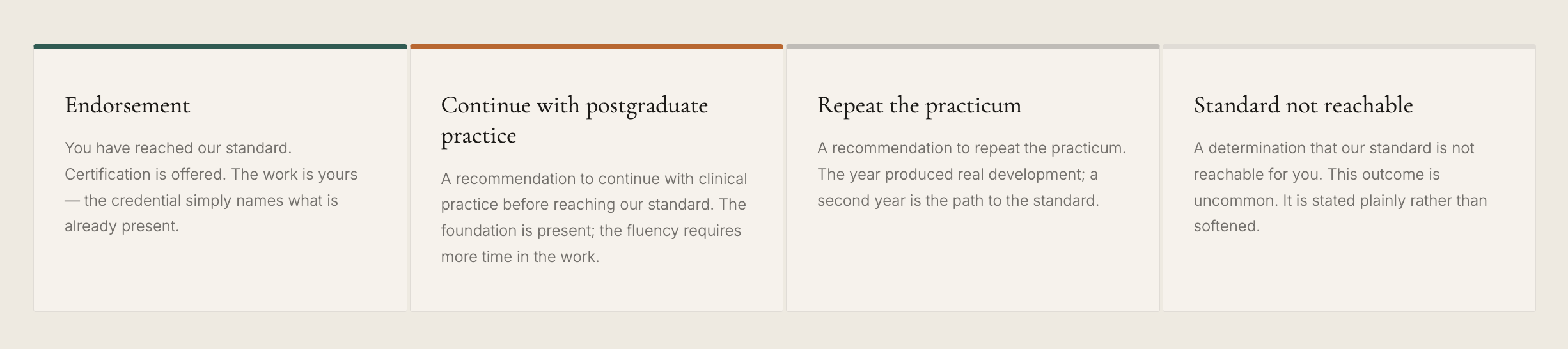
The evaluation assesses autonomic tracking competence directly. It falls into one of four outcomes. We offer a certification for practitioners who reach the standard — a formality that acknowledges what you have built, not a credential that defines it.
Some participants do not pass.
INVESTMENT
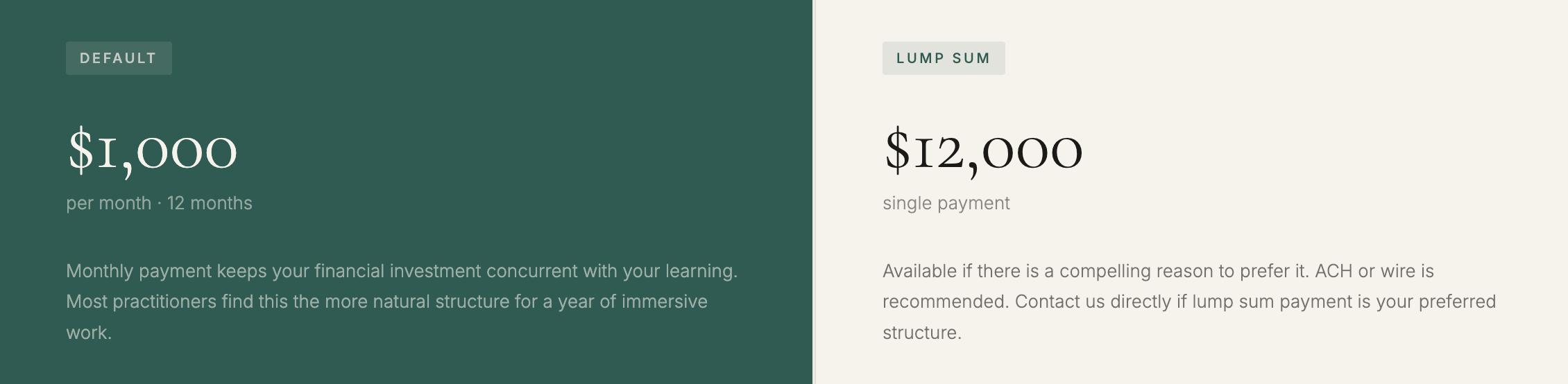
The practicum is $12,000.
Monthly payment is the default. It is structured to keep your financial investment concurrent with your learning. Lump sum payment is available if there is a compelling reason to prefer it.
APPLICATION
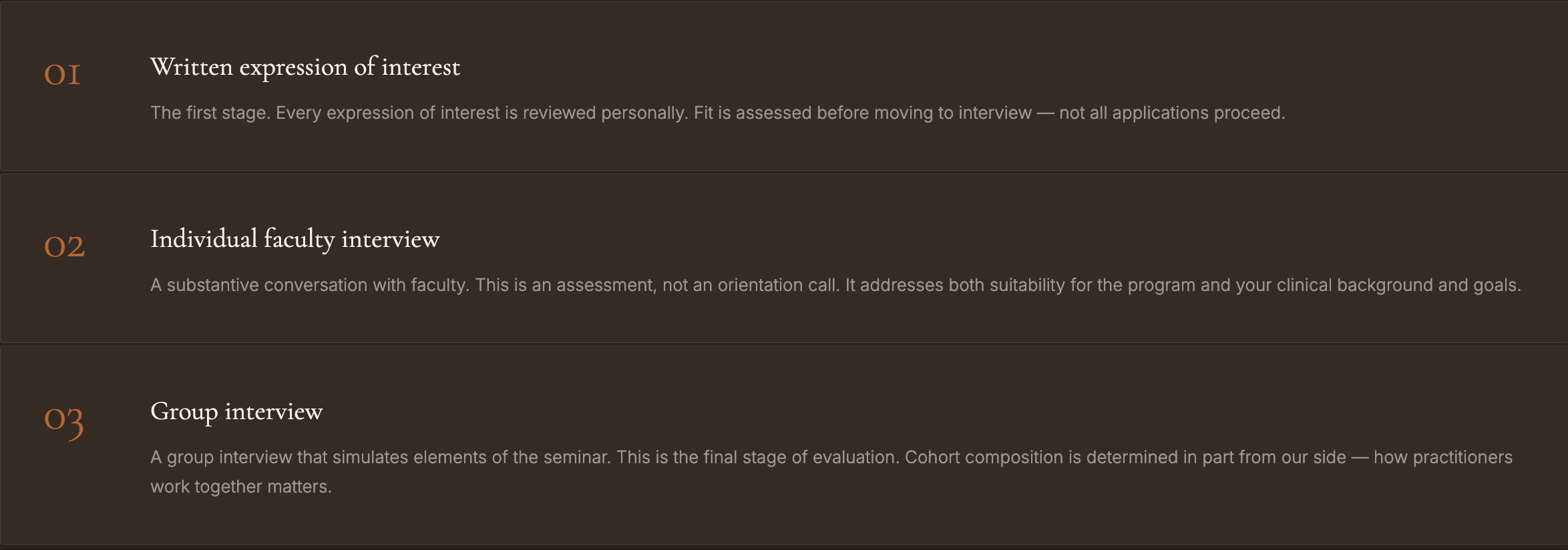
Three stages.
Fit is assessed at each.
Not all expressions of interest proceed to interview.
JOIN US
Our 2026-2027 cohorts are complete. Expressions of interest are for next year’s cohort: Autumn 2027- Spring 2028.
Cohort places are limited to twelve and held in the order applications are confirmed.