PROFESSIONAL TRAINING ⌖ LIVE LECTURE SERIES
Architecture and Dynamics of the Living Nervous System
A Lecture Series in
Living Autonomic Physiology
You’re in the right place if
–Now that the vagus nerve is TikTok famous, you have stopped trusting claims about the magical powers of stimulating it– or lost the ability to differentiate real science from the marketing hype of the wellness industry
-You regularly have clinical intuitions that standard neuroscience diagrams cannot account for but recognize something neurological is happening
-The Polyvagal controversy has left you at a loss, or the critique of The Body Keeps the Score has unsettled your understanding of the relationship between the body and trauma
If you see yourself in any of the above, this is a series for you.
In this series we will rebuild your understanding of the autonomic nervous system from the inside out and the bottom up, transforming the way you visualize, understand, track, and experience your own embodied nervous system and the nervous systems of your clients.
Listen to an audio preview of the Lecture Series.
A 15-minute audio preview of the lecture series.
Background on the Lecture Series
Five Sessions. One pass.
Saturday, October 10, 2026
From First Principles: Category Errors in the Foundations of Neuroscience
In this training we will explore the history of autonomic science all the way back to Galen of Pergamon –the Roman Anatomist in the 1st century AD who first identified the vegetative nervous system.
We will walk the forest to experience the visionary strangeness of the Father of modern neuroscience, Santiago Ramon Y Cajal.
We will join Walter Cannon for the discovery of the fight-flight response, and meet Otto Loewi who identifies acetylcholine.
The lecture take us through the history of the discipline, identifying four compounding sources of structural error embedded in the field's originating neuroanatomical maps and makes the case for building from different epistemic ground.
We will explore why these structural errors have set modern autonomic physiology on a foundation that must be restructured from first principles, and the path to so doing.
Saturday November 7, 2026
What is the Nervous System? What is Stress? What is Wellbeing?
Although most modern people know that the nervous system exists, and that it transmits signals through the body via electrical impulses, the distorting effects of a brain-centric bias, and the field’s failure to understand and articulate a systems perspective create conditions such that the MEANING of the nervous system– the purpose for which it evolved, its primary functional domains, why it is organized the way that it is, are lost on most people, including practitioners. In this second lecture, we ask WHY?
What is the teleological import of the nervous system and specifically the autonomic systems?
How are these systems arranged?
Why do we view interoception – an inward sense many people do not know they have – as the Mother of the Senses?
Since 80% of the pathology that brings modern people into primary care is stress-related, and everyone experiences stress, why does our ability to define it break down so rapidly in the face of systematic inquiry? Why don’t most people know that there are two entirely different categories of stress, one hot, one cold. One that mobilizes and accelerates. One that immobilizes and decelerates.
Is stress in the body? Does the body keep the score? Or, as recently proposed by Steven Kotler at al., is traumatic stress a function of overweighting danger priors?
In this lecture we will create a set of specific typologies for stress, explore why an identical event can compromise the health of one person’s nervous system while making another’s more resilient, what exactly allostatic loads are made of, and how they are stored in the body and mind.
We will also elaborate a positive definition of autonomic health, which is not enduring calm, but rather collaborative coordination of autonomic systems in safety, appropriately calibrated response flexibility to threat, and capability to return to baseline when safety returns.
TEXT: Towards an Accurate In Vivo Reconceptualizing of Autonomic State
Saturday December 5, 2026
Redrawing the Neuroanatomical Maps
Based on the category errors identified in lecture one, we will deep-dive into what is required to adjust the neuro-anatomical architecture, boundaries, and density parameters of the primary autonomic systems.
Polyvagal Theory updated our understanding of these systems, but we propose that it does not go far enough, and it misses major organizational features of two of these systems because it misunderstands when to map them (not at birth, as Polyvagal Theory demarcates, but rather after the fontanelles close, around 18 months of age, when myelination of these systems has completed).
We will closely examine neurogenesis and the source-to-target principal, which explains how neurons grow. We will deep-dive into early neuro-embryology, examining how certain neural conduits and relationships are hard-wired from very early in utero.
We will explore fine autonomic fibers - including c-tactiles, that are less than 1/100th the width of a human hair, and explore the density of these fibers, which degrade shortly after death and are therefore not included on any neuro-anatomical maps you have ever seen.
From these four layers of boundary revision we will remap the primary autonomic systems in the living body and experience their anatomy.
Cooperative Coordination and Hierarchical Decoupling
The lectures explains the 3-variable construction of autonomic state from neuroception (moment-to-moment embodied neural detection of safety, danger, and lifethreat), recruited neurology, and pervading neurochemistry.
Our work in Autonomics proposes a 3-variable construction of state that coordinates neurological systems in health-creating states, and observes their patterned decoupling under danger and lifethreat.
In this lecture we get into the expanded autonomic terrain that emerges when we have an autonomic model with three variables, rather than two.
We also viscerally and experientially explore the primary neurochemistries that affiliate with autonomic neurology to color autonomic states.
Saturday January 9, 2027
Breaking the Stasis in the Polyvagal Controversy
Polyvagal Theory has profoundly influenced clinical practice, but recent publications (most significantly Grossman et al., 2026) have challenged the theory’s foundations, leaving many clinicians unsettled, and the field in an uncomfortable stasis.
We review the major tenets of the critique, including the places where the Grossman critique aligns with our own research and clinical praxis, examine places we think PVT still holds water, explain why we think the debate is UNRESOLVABLE as currently articulated, and how it could be reformulated to answer the question through an experimentally testable hypothesis.
This lecture is timed with the release of Gabriel’s paper The Polyvagal Standoff as part of the January issue of the Psychotherapy Networker, which is devoted to the current status of Polyvagal Theory.
TEXT: Breaking the Stasis in the Polyvagal Controversy (forthcoming)
Saturday February 6, 2027
A live Q&A for series subscribers, in which we synthesize the five previous trainings and their primary insights. Gabriel will review major themes, answer questions that may have emerged, and help to support participant’s deeper learning and integration of this series into your worldview and praxis.
Saturday March 6, 2027
Synthesis for Series Subscribers
ABOUT YOUR INSTRUCTOR
Natureza Gabriel Kram
Author of…
⌖Body as Verb: The Genius of the Vertebrate Movement System (forthcoming)(2026)
⌖Ground: How Modernity Disconnected from the Earth, Why it Matters, &How to Fix It (2025)
⌖The Neurobiology of Connection: Re-Wilding Your Deep Nervous System for Wellbeing (2024)
⌖A Field Guide to the Missing Words of North America (2023)
⌖Finding Home in Your Nervous System (2025)
⌖Autonomic Triage (2025)
⌖The Role of Autonomics in the Origin and Healing of Chronic Illness (2025)
Natureza Gabriel Kram studied humanities and neuroscience at Yale University, and Creative Writing at Stanford University. From 2004 to 2009 he served as Executive Director of the Mind Body Awareness Project, which developed a new national program model of trauma-informed mindfulness training for incarcerated youth. In 2010 he founded Applied Mindfulness, Inc., whose first client was the Bayview Child Health Center, where he worked closely with pioneering toxic stress expert Dr. Nadine Burke Harris, who would go on to become the inaugural Surgeon General of California. While working with Nadine, Gabriel developed a trauma-focused / body-first approach to mindfulness for serving young people with Adverse Childhood Experiences. For four years he revised this curriculum and applied it in various clinical settings until he encountered the work of Darcia Narvaez, PhD, Professor Emerita of Psychology at the University of Notre Dame, and author of Neurobiology and the Development of Human Morality, with whom he would go on to collaborate. He pivoted the firm from optimizing for mindfulness to understanding the neurobiological foundations of connection and relationship, essentially shifting its disciplinary home from mindfulness to autonomic physiology, and spent a decade building an advisory of over a hundred individuals from 24 healing disciplines and 25 cultures around The Neurobiology of Connection. In 2019 his firm established an intellectual property development agreement with Polyvagal Science LLC, and working closely with Stephen W. Porges, PhD, the Developer of Polyvagal Theory, Gabriel wrote and art directed the Official Polyvagal Poster: the only complete authorized visual depiction of Polyvagal Theory. From 2021-2023 Gabriel ran the Polyvagal Study Group on Facebook: an international group of 5,000 wellness practitioners studying Polyvagal Theory. In 2024 Gabriel formally differentiated his work from Polyvagal Theory.
Gabriel has written about the nervous system for Psychology Today, and writes about the nervous system for the Psychotherapy Networker. His work has been requested by the Stanford University School of Medicine’s Prevention Research Center, leading executive coaching and consulting firms including McKinsey/ Aberkyn, and The Leadership Circle, as well as the social/ecological movement Extinction Rebellion (where he worked with the founders and visioning team), and tribal leaders of Indigenous communities. He is faculty at the Omega Institute for Holistic Studies. He has lead over 2,500 trainings internationally, and trained tens of thousands of practitioners. Neuroplasticity expert Rick Hanson calls him, “My favorite outlaw neuroscientist.”
“I am a researcher, healer, and teacher focused on the LIVING autonomic nervous system. Most people do not realize that every single drawing you have ever seen of the nervous system was made from a cadaver. For the same reason that I would not take you to a lumberyard if I wanted to teach you about the forest, the entire thrust of my research, clinical praxis, and teaching is oriented towards the felt legibility of the living Autonomic Nervous System, which is as different from the dead as a living oak is in summer from its barren winter version.
This series is the culmination of more than twenty years of work, and I’m honored to be able to share it with interested people from around the world. I hope you’ll join me. I believe it will change the experience you are having of the body you are living in.”
-Gabriel
FORMAT
What to expect.
Content assumes baseline familiarity with the Autonomics model. (There is a pre-session September 19 that can give you this familiarity.) You can also gain it through reading one of our books, or perusing our research papers.
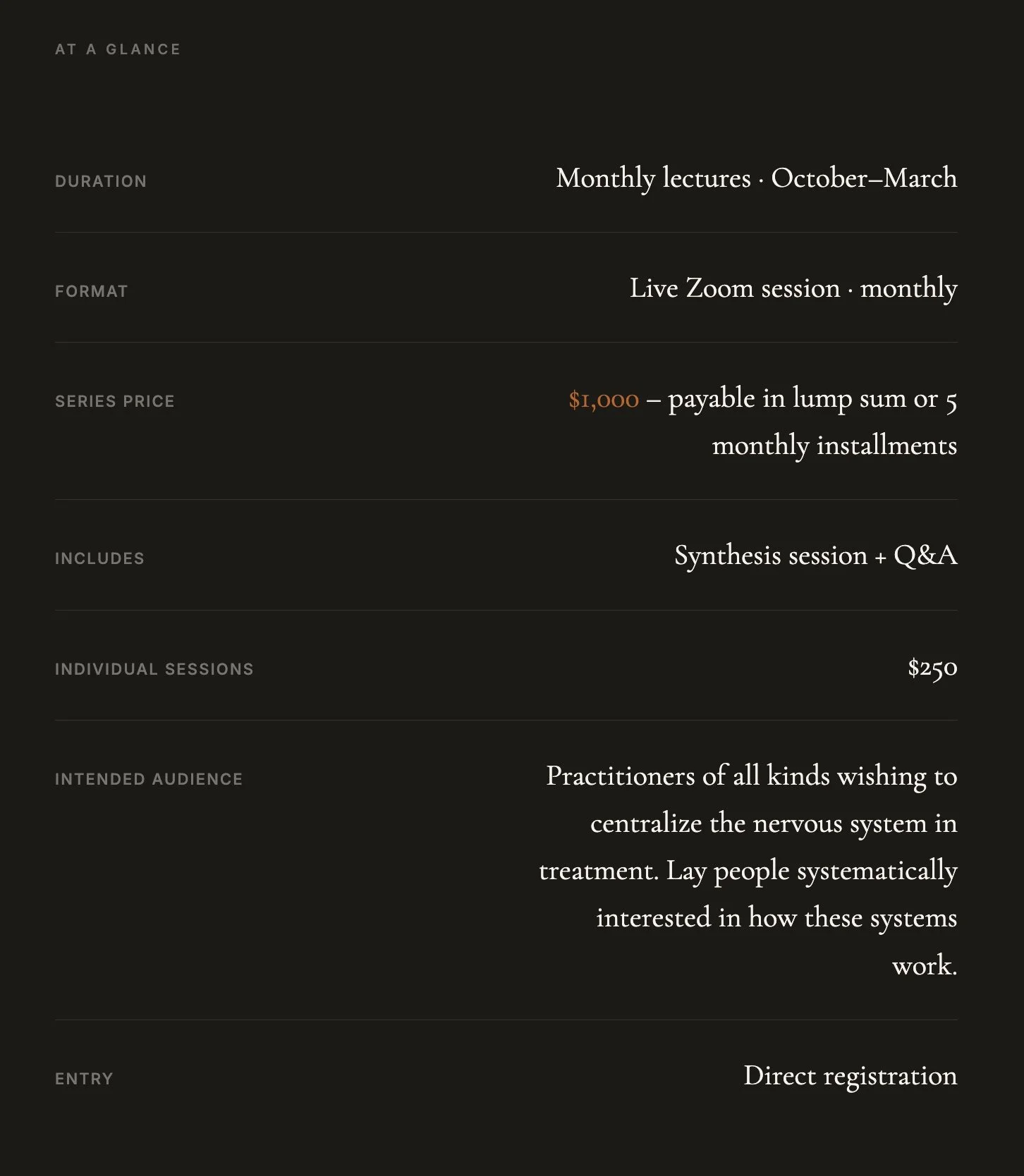
Each session runs three hours, live on Zoom.
Every registrant — season pass or single session — receives the recording.
The March synthesis session is a closing seminar for lectures series pass holders: a consolidation of the season's threads, not a repeat of earlier content.
All five lectures, plus the March synthesis session — available only to season pass holders. Live attendance and a recording of each session.
PROGRAM STRUCTURE
Get your lecture series pass.
FULL SERIES ⌖ RECOMMENDED
One lecture (subject to availability). Live presentation and access to the recording.
INDIVIDUAL TICKETS ⌖ ONE-AT-A-TIME
TESTIMONIALS
“Gabriel is my favorite outlaw neuroscientist.”
-Rick Hanson, PhD, NYT-bestselling author and neuroplasticity expert
“A seismic event.”
“Full of brilliant trans-disciplinary insights.”
-Philip Shepherd, Developer of the Embodied Present Process (on the publication of GROUND)
-Darcia Narvaez, PhD, Professor Emerita of Psychology and Developer of the Evolved Nest (on the publication of The Neurobiology of Connection)
“A perfect bridge between neuroscience and the wisdom traditions.”
-JD Daniels, MD, MPH Professor of Family & Community Medicine, Assistant Dean of Students for SIU Medicine
“Gabriel brings an unusual combination of knowledge and skills, and a truly remarkable capacity to synthesise and articulate the insights these have afforded him. These lectures will change the way you think about humanity and offer hope in challenging times.”
-Sarah Stewart-Brown, Professor Emeritus and Chair in Public Health (University of Warwick, UK)
“Your work is outrageously profound.”
-Dr. Aubrey Wallace, ND. Naturopathic Physician and Medical Intuitive
“When I study with Gabriel it requires my total attention. I am unlearning at basically the same velocity that I am learning. I am watching ideas fall apart and reconfigure before me in realtime.”
-Kim Barthel, Founder, Relationship Matters, Occupational therapist, speaker, multi-disciplinary teacher, mentor and best-selling author