
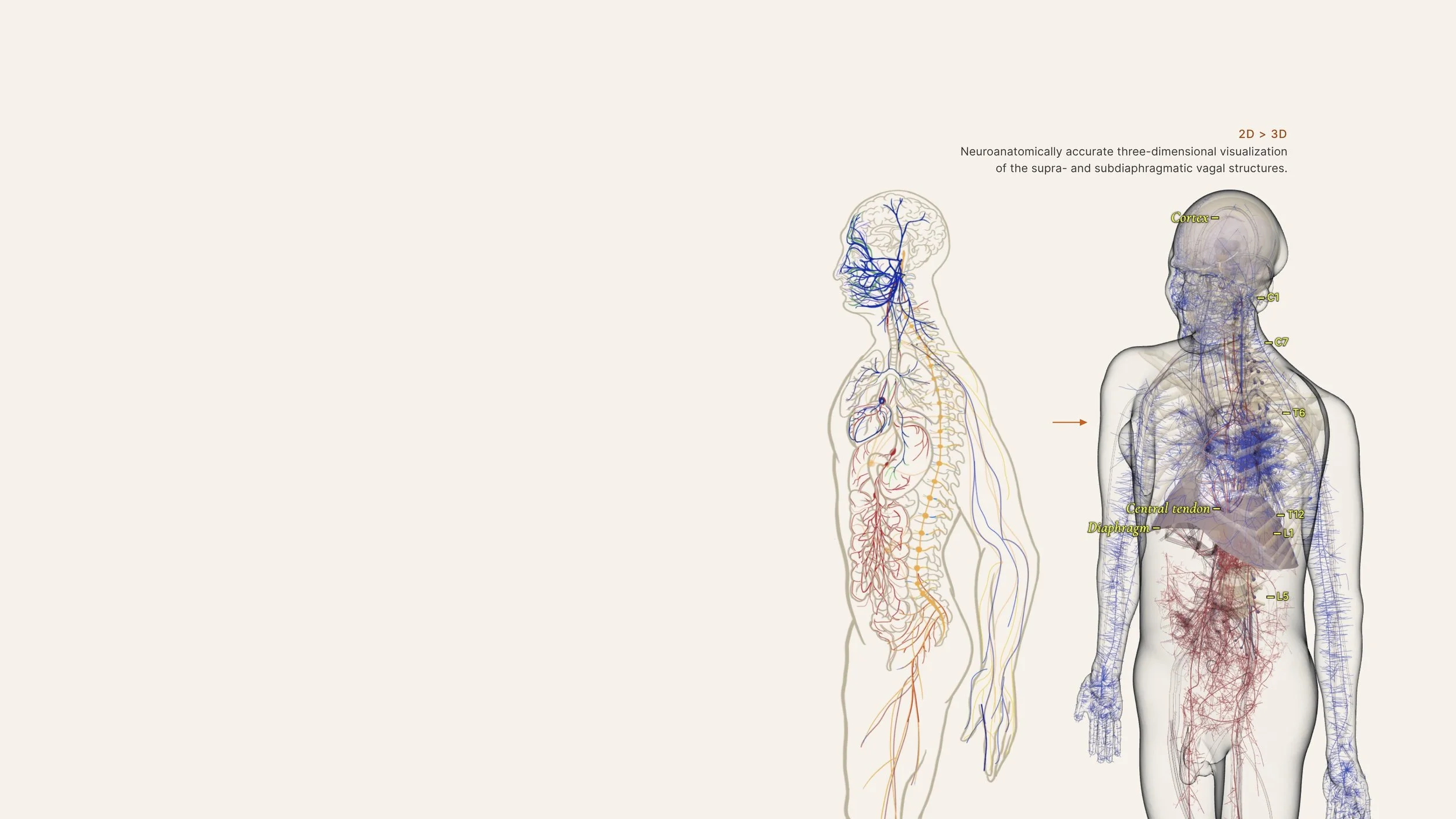
RESEARCH ⌖ WORKING PAPER ⌖ OCTOBER 2026
Breaking the Stasis in the Polyvagal Controversy
Two category errors, a missing variable, and a measured boundary.
Gabriel Kram, Hearth Science
Heather MacDuffie, PhD, Lifeworks of Maine
A response to the January 2026 exchange between Grossman et al. and Porges in Clinical Neuropsychiatry. The paper shows why the debate cannot be settled as currently framed, names the variable both positions leave out, and replaces the verdict with predictions that can be tested in living human subjects.
GET THE CLINICIAN BRIEFING BELOW…
IN RESPONSE TO: Grossman et al., “Why the Polyvagal Theory is Untenable” | Porges, “When a Critique Becomes Untenable” | STATUS: Under Journal Submission - Preprint Available
Kram, G., & MacDuffie, H. (2026). Breaking the Stasis in the Polyvagal Controversy: Two Category Errors, a Missing Variable, and a Measured Boundary. Preprint.
THE PAPER IN BRIEF
A debate that cannot be settled as framed.
Grossman has been making, and Porges has been deflecting, the same core arguments since 2007. In January 2026, Grossman et al. called Polyvagal Theory untenable; Porges replied.
Both positions inherit a set of category errors from neuroscience. Those errors place the one variable needed to settle the debate outside the reach of either side’s claims.
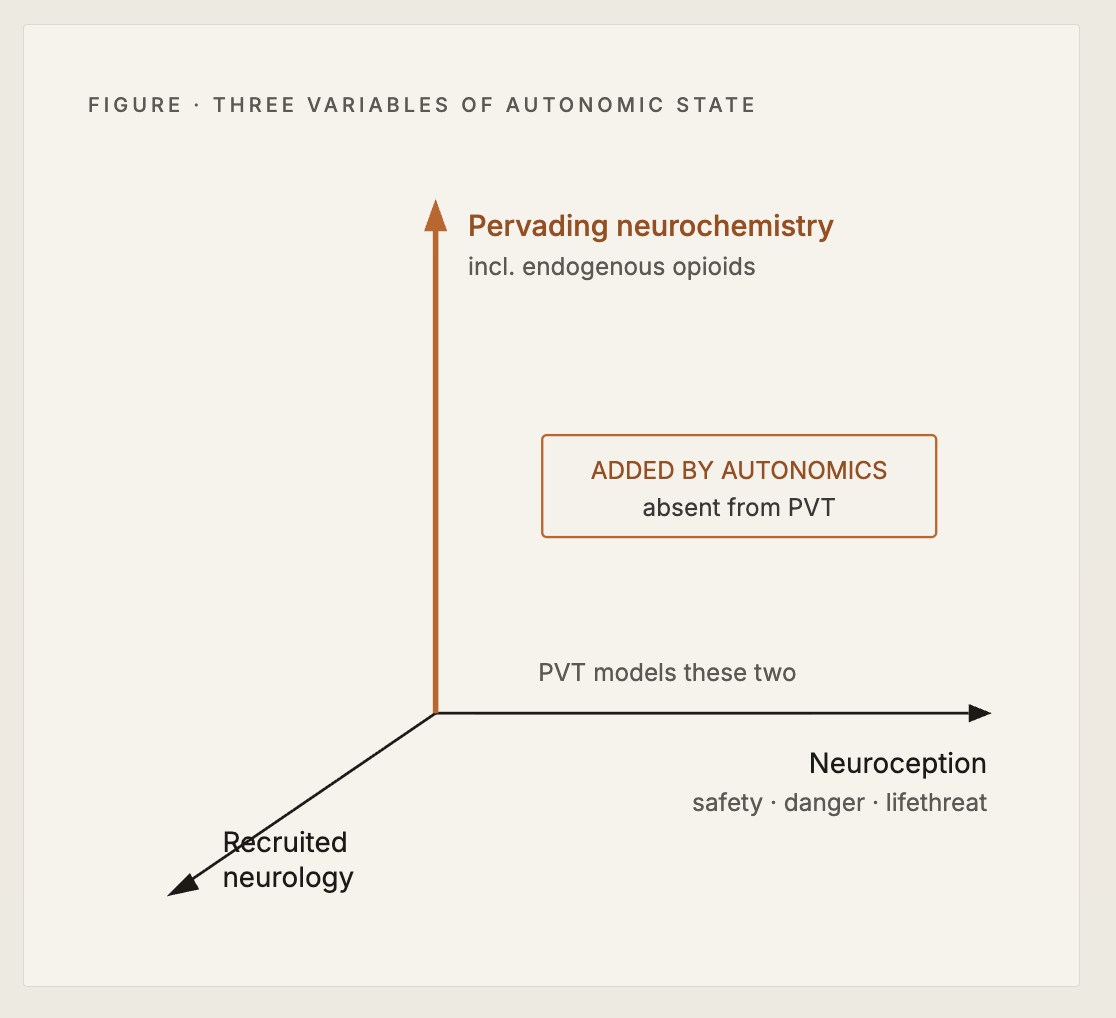
The paper adds that variable, pervading neurochemistry, and shows how it restructures the argument.
The untenability verdict does not follow. Neither does Porges’ account of shutdown. Both are replaced by predictions that can be tested.

THE MISSING VARIABLE
Pervading neurochemistry, and what it does to the shutdown debate.
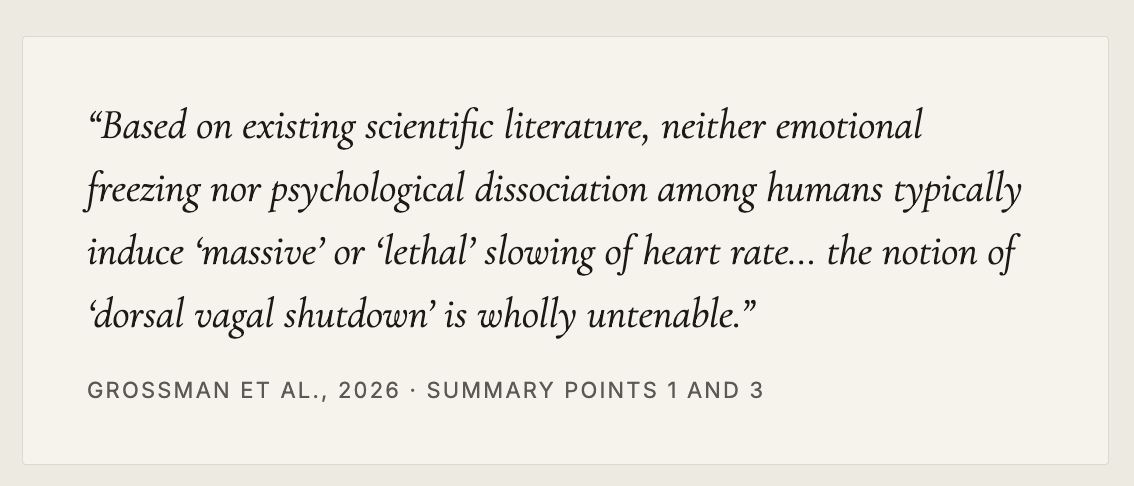
The endogenous opioids, a class of neuropeptides absent from Polyvagal Theory, distinguish shutdown from freezing by their neurochemistry.
Dissociation is an experience that can accompany either state. It is not a state in its own right.
Grossman et al.’s physiological evidence is accurate. Freezing and dissociation do not typically produce profound bradycardia, and on this account they are not shutdown, so the evidence does not bear on shutdown itself.
The proposed mechanism operates at the nucleus ambiguus, the structure Grossman et al. themselves identify. It does not depend on the dorsal motor nucleus.
Neither side has specified the neurochemistry of shutdown, so the untenability verdict does not follow. Neither does Porges’ account, in which the dorsal vagus produces shutdown by neural action alone.
FOR CLINICIANS
Four contributions, and what changes in practice.
Beyond the shutdown question, which breaks the stasis, the paper makes four contributions with direct clinical consequences.
01
The sensory side of the autonomic nervous system, assuming its rightful place.
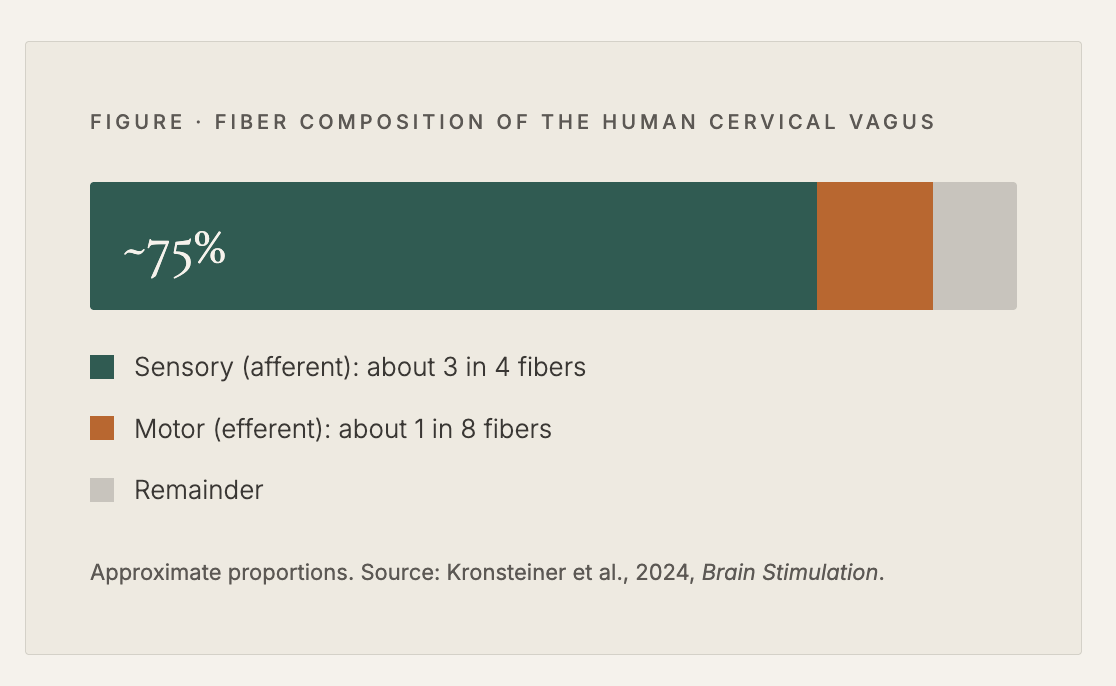
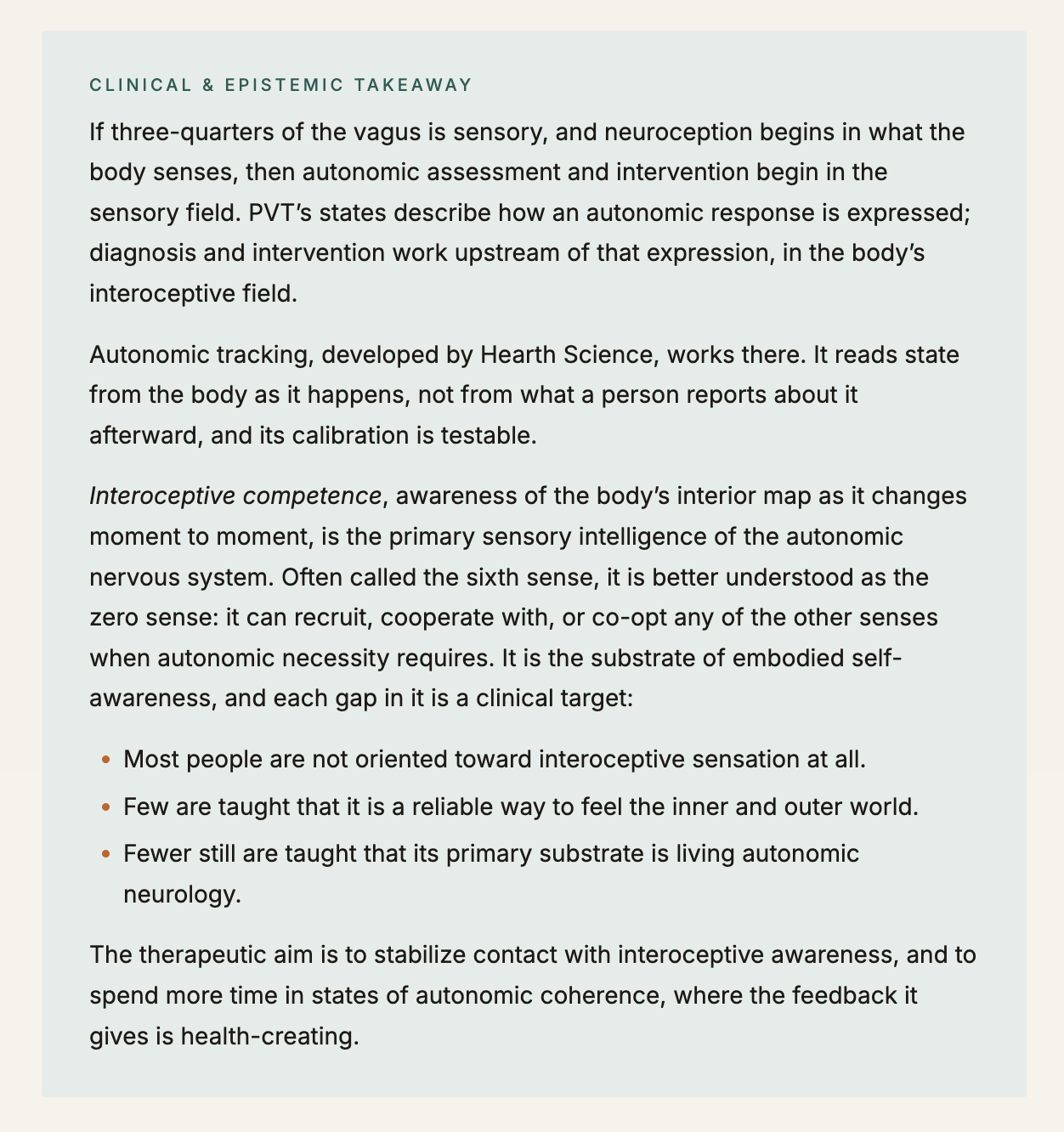
The vagus, the nerve at the center of this debate, is predominantly sensory. Roughly three of every four fibers in the human cervical vagus carry information inward from the body, against about one in eight carrying motor output (Kronsteiner et al., 2024).
Autonomic science has nonetheless been built around motor output. Langley defined the system by its motor pathways in 1898 and placed sensory fibers outside it, and the field has largely kept that emphasis.
Polyvagal Theory inherits it. Its structural terms (the ventral vagal complex, the dorsal vagal complex, the social engagement system, the vagal brake) all name motor structures.
PVT’s ordering is correct: neuroception comes first, and the autonomic response follows. But neuroception, the process on which the rest of the theory depends, has never been given an anatomy. The paper locates it in the sensory architecture, organized as a map of the body’s interior by location and by the kind of stimulus sensed, not by threat.
CLINICAL DOMAINS
02
The differentiated vagus, placed on direct measurement
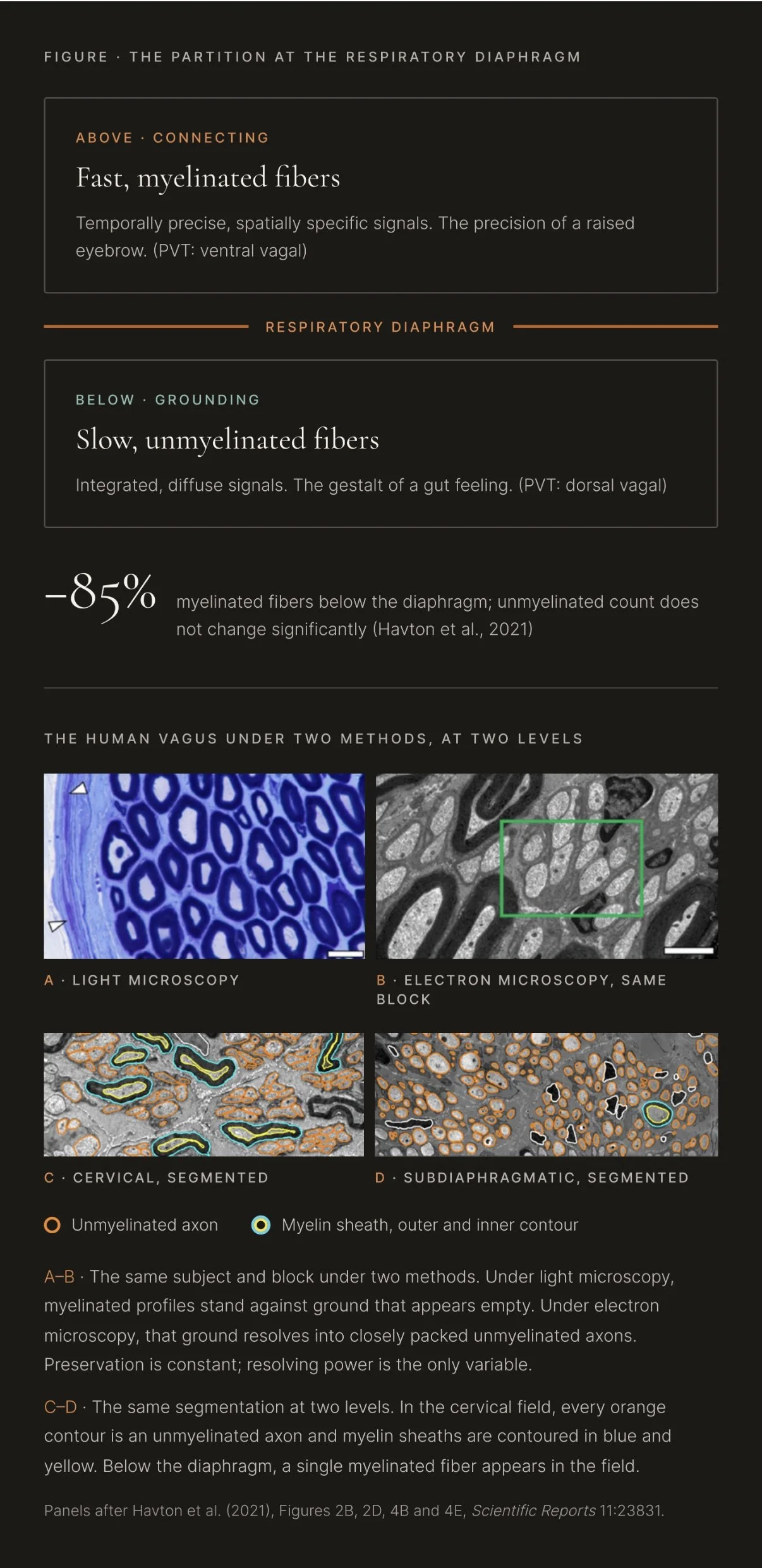
PVT draws its ventral/dorsal distinction on the motor side, from brainstem nuclei and comparative anatomy.
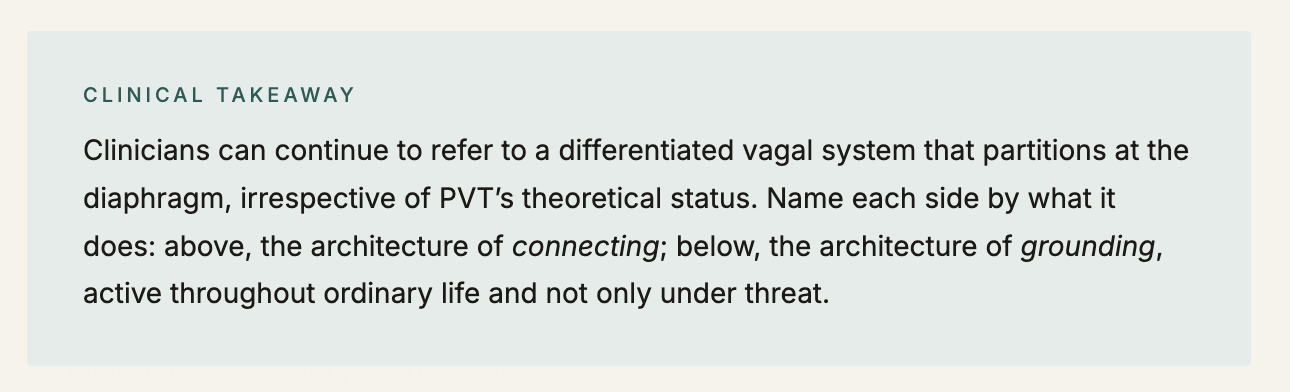
The same partition at the respiratory diaphragm appears in the nerve as a whole, including its sensory architecture.
Electron microscopy of human vagus from organ donors (Havton et al., 2021) shows myelinated fibers fall by roughly 85 percent below the diaphragm.
Because the partition is measured rather than inferred, it holds whether or not PVT endures as a theoretical architecture.
CLINICAL DOMAINS
03
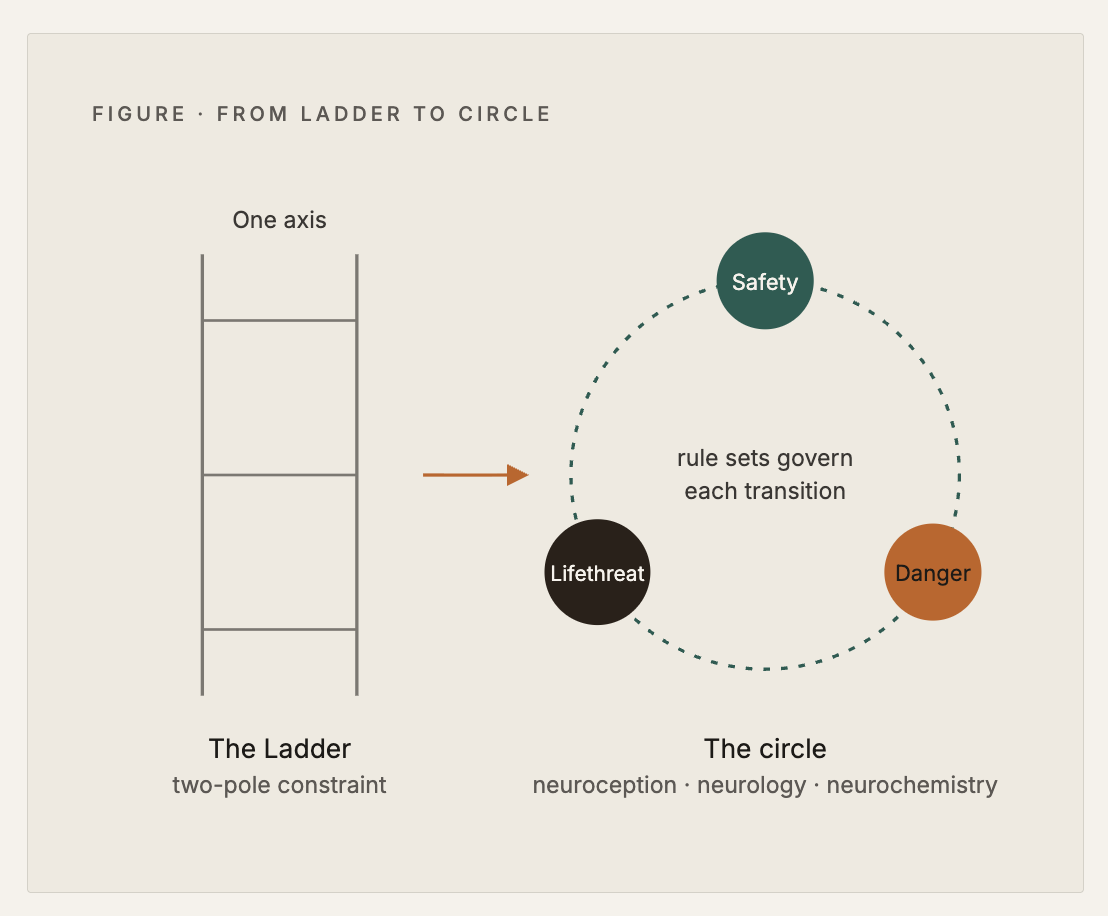
A new explanation for passage between danger and lifethreat
PVT’s taxonomy of threat response rests on comparative evolutionary anatomy, including inferences drawn from the vagus of a 400-million-year-old fish.
The paper offers a neurochemical explanation for the clinically observed movement between danger and lifethreat states that does not depend on that phylogenetic framework.
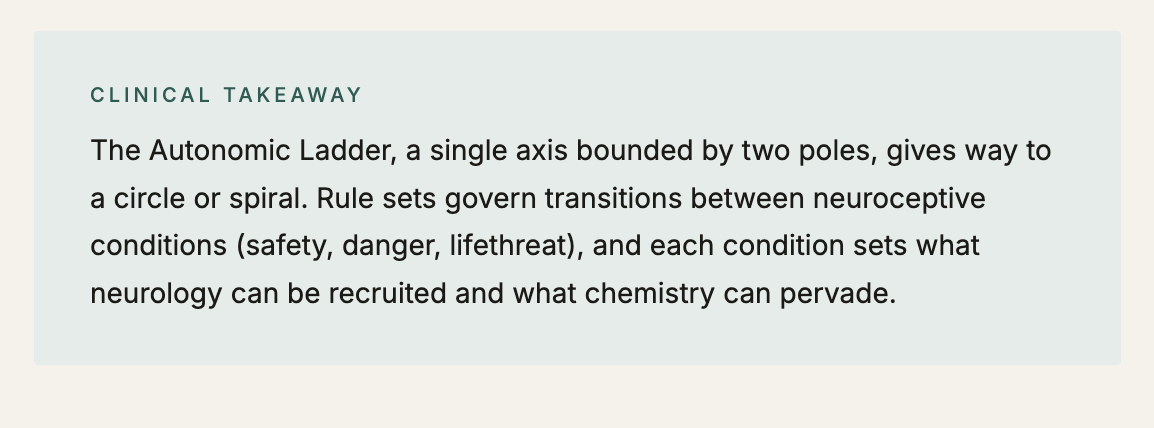
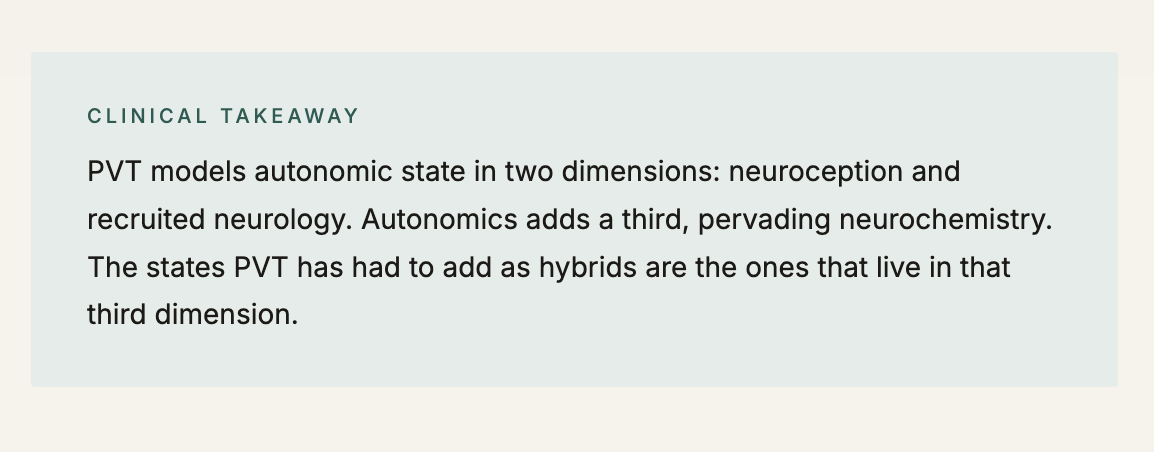
Autonomic state becomes the interplay of neuroception, recruited neurology and pervading neurochemistry, rather than a position on a single axis.
Because the ground is neurochemical rather than phylogenetic, it holds whether or not PVT endures as a theoretical architecture.
CLINICAL DOMAINS
04
Hybrid states as the edge of a missing dimension
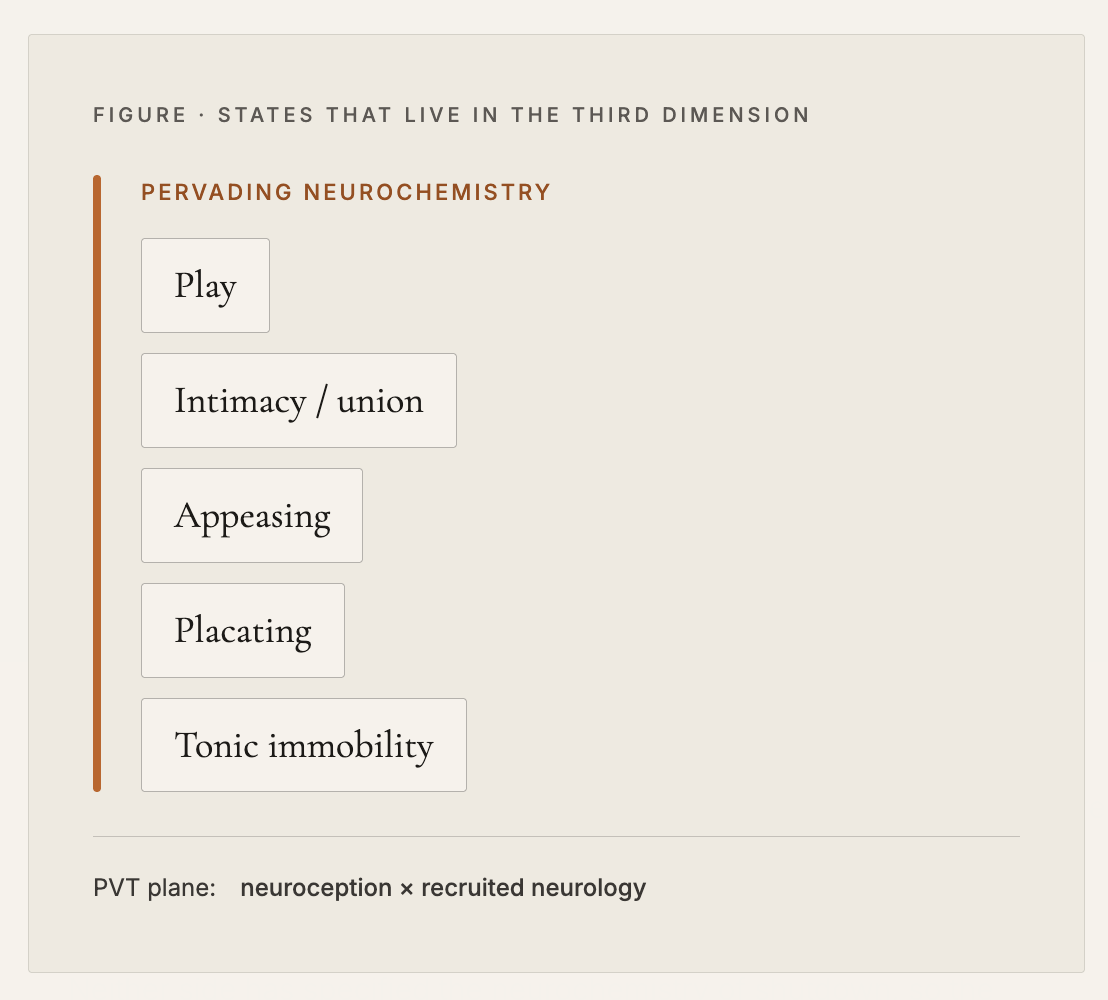
Appeasing, placating, intimacy/union, play and tonic immobility are clinically significant and frequent.
PVT treats them as hybrid states built from multiple neural systems.
The paper argues they are not primarily autonomic composites. They are the visible edge of a whole dimension PVT does not model.
CLINICAL DOMAINS
A MEASURED BOUNDARY
Neither Porges nor Grossman et al. has specified the neuro-chemistry of shutdown.
The paper replaces the verdict with predictions that can be tested in living human subjects, which makes the controversy resolvable, breaking the
stasis in the field.
Established
Fiber counts and the diaphragm partition, from direct measurement of human tissue.
Framework
The three-variable model of autonomic state.
Testable
The neurochemistry of shutdown, and the predictions that follow from it.
THE CLINICIAN BRIEFING
The paper is written for specialists. The briefing is written for practice.
A structured breakdown of Breaking the Stasis for working clinicians, delivered to the Hearth Science mailing list.
The argument in plain terms, without the anatomical prerequisites
The four clinical takeaways, and what each changes in assessment and intervention
A terminology map: PVT terms alongside their Autonomics equivalents
What is established, what is framework, and what remains hypothesis