
RESEARCH & SCIENCE
A new map of the living autonomic nervous system.
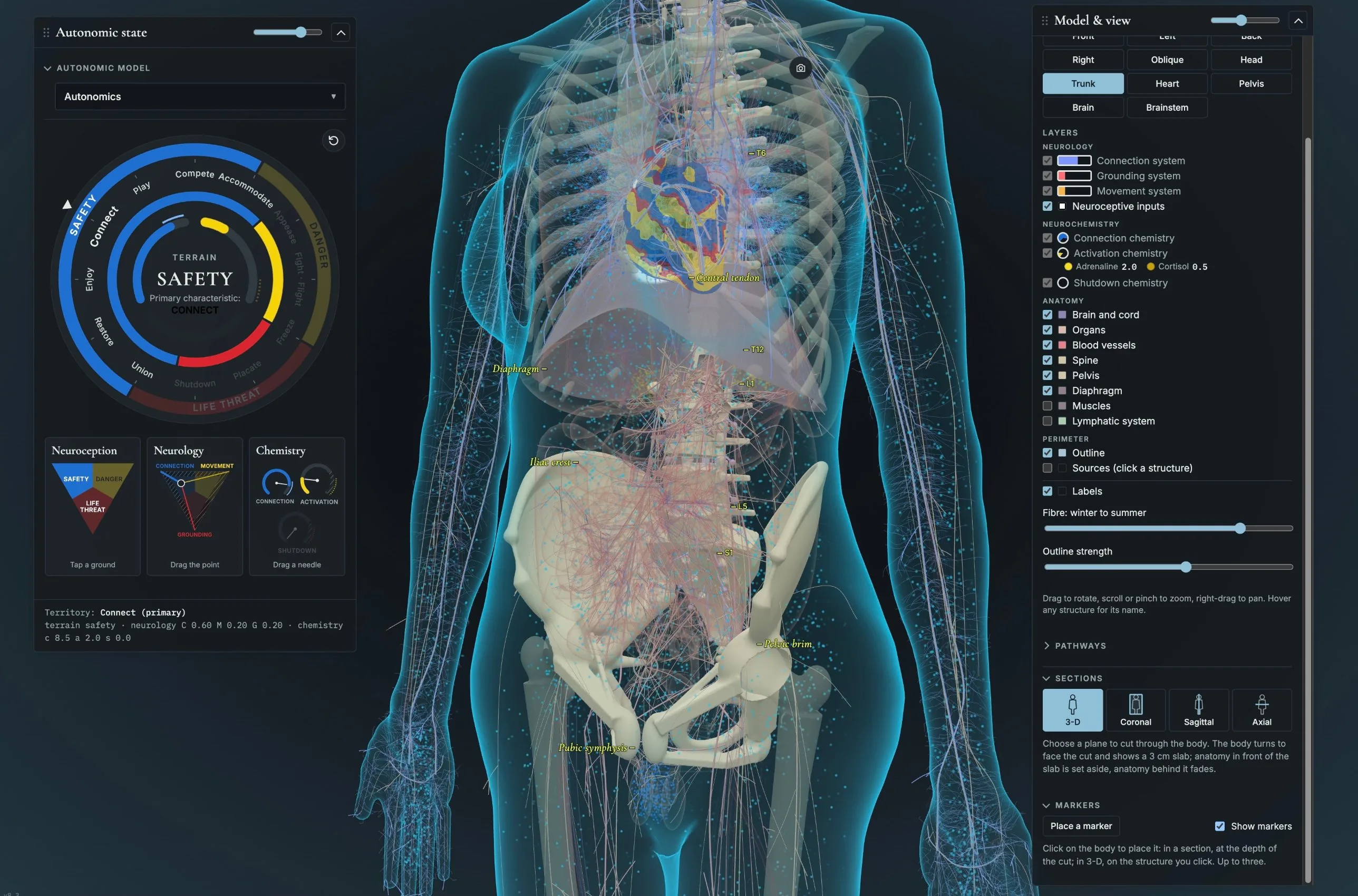
Autonomic science has been constructed on neuroanatomical maps derived primarily from cadaver dissection that cannot map the fine fiber networks that constitute the living dynamism of the afferent ANS. The autonomic nervous system — observed in vivo, in real clinical encounters, across thousands of cases — behaves quite differently than those maps predict.
preprints published on ResearchGate.
papers in production extending the foundation model and its implications.
people informing the foundation model, from 50 countries around the world.
advisors spanning 25 disciplines in the healing arts– from neurophysiology to developmental biology to connection science to deep ecology to mindful awareness to Indigenous Lifeways to data science – and 24 cultures, many of them Indigenous.
THE RESEARCH PROGRAM
The Autonomics research program begins with the gap between observed clinical phenomena and the neural and neurochemical cartography that purports to undergird it. It documents what the living system actually does, elaborates a refined three variable autonomic context-sensing, neurological, and neurochemical framework that accounts for those observations, and builds the diagnostic and taxonomic infrastructure a new clinical science requires.
The work is published as preprints while peer-reviewed submission proceeds.
START HERE
THE FOUNDATION · SEPTEMBER 2025
Towards an Accurate In Vivo Reconceptualizing of Autonomic State
The foundational paper. Introduces the three-system model, the three-variable construction of autonomic state, and the clinical validation dataset. This is the foundation map the subsequent papers extend.
ADDRESSING POLYVAGAL THEORY · OCTOBER 26, 2026
Breaking the Stasis in the Polyvagal Controversy: Two Category Errors, a Missing Variable, and a Measured Boundary
with Heather MacDuffie, PhD
Polyvagal theory has shaped a generation of clinical practice. Grossman et al.’s 2026 critique with 38 experts in vagal physiology has dramatically challenged its status. Yet neither party articulates the variable that would permit adjudication of the debate in living subjects. This paper deconstructs the debate and poses an experimentally testable pathway for moving forward.
FOR CLINICIANS · NOVEMBER 2026
Breaking the Stasis in the Polyvagal Controversy: A Structured Briefing for Clinicians
The paper is written for specialists. The briefing is written for practice. A structured breakdown of Breaking the Stasis for working clinicians.
ALL PREPRINTS · NEWEST FIRST IN EACH GROUP
FIELD POSITIONING
Forthcoming December 1, 2026
Defining the Immobility States in Trauma Science
with Heather MacDuffie, PhD
November 2026
A Phenomenon in Search of a Mechanism: Phenomenon, Synthesis, and Mechanism in the Polyvagal Controversy
with Heather MacDuffie, PhD
A companion paper to Breaking the Stasis that identifies the mechanism polyvagal theory was designed to explain and proposes an alternative mechanism that supersedes it.
August 2026
April 2026
Moving Past the Polyvagal Controversy: An Expanded Clinical Framework for Observing Autonomic State
with Heather MacDuffie, PhD
Polyvagal theory has shaped a generation of clinical practice. This paper addresses the controversy directly and introduces the Autonomics framework as an expanded model that supersedes the debate.
FOUNDATION
September 2026
August 2026
July 2026
There is No Such Thing as a Primitive Reflex: Restructuring Reflexes as a Distinct Category of Hardwired Autonomic Calibration
What developmental neuroscience calls ‘primitive reflexes’ are the visible motor output signatures of a sequential series of foundational autonomic initialization events. The paper introduces the term restructuring reflex as the correct functional category.
July 2026
The Perinatal Autonomic Cascade: A Sequential Model of Neonatal Autonomic Initialization
The Perinatal Autonomic Cascade is a precisely ordered sequence of neurological initialization events that completes once after birth and establishes the foundational parameters of the organism's autonomic architecture for terrestrial life.
June 2026
Forest Not Lumberyard: Methodological Bias, Structural Error, and a Necessary Transformation of the Epistemic Ground of Autonomic Neuroanatomy
The most foundational argument in the program. Identifies four compounding sources of structural error in the field's neuroanatomical maps and makes the case for building from different epistemic ground.
CLINICAL IMPLICATIONS
October 2025
A Typology of Chronic Defensive Autonomic States as Specific Antecedents to Disease Etiology
Approximately 80% of primary care presentations are stress-related. This paper provides what has been missing: a specific taxonomy linking chronic autonomic states to disease categories, and a corresponding framework for more targeted intervention.
DIAGNOSTICS
October 2025
Autonomic Diagnostics: Towards Accurate In Vivo Autonomic Measurement
HRV has become the de facto standard for autonomic measurement. This paper identifies its structural limitations and proposes a more accurate alternative grounded in direct in vivo observation.
METHODOLOGY
March 2026
Autonomic Tracking: Methodological Viability of an Alternative Epistemological Approach
The epistemological argument for hard-ground tracking as a valid mode of in vivo autonomic observation — and a methodological defense of the approach underlying this research program.
ALSO FROM THE PROGRAM
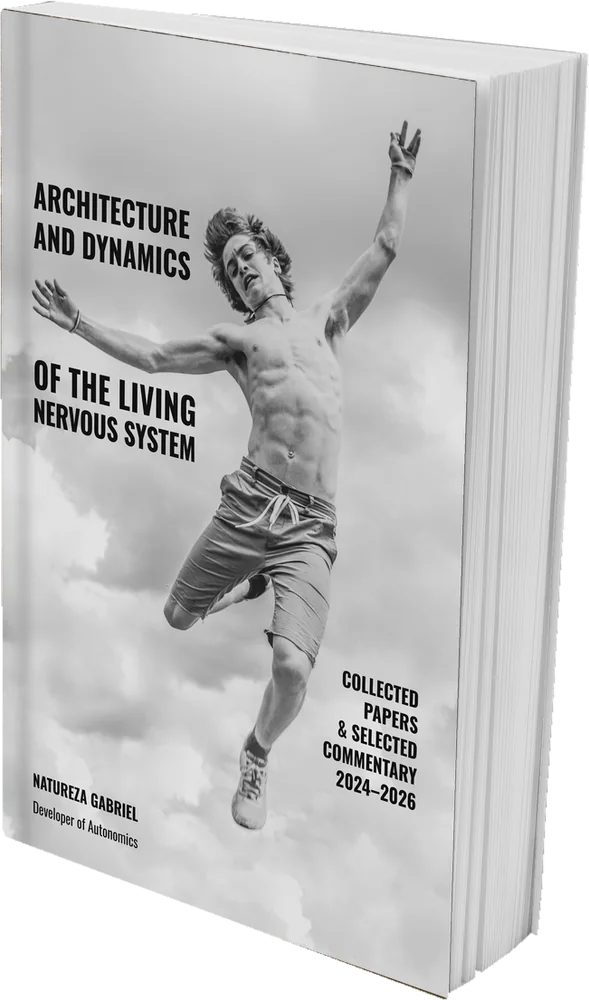
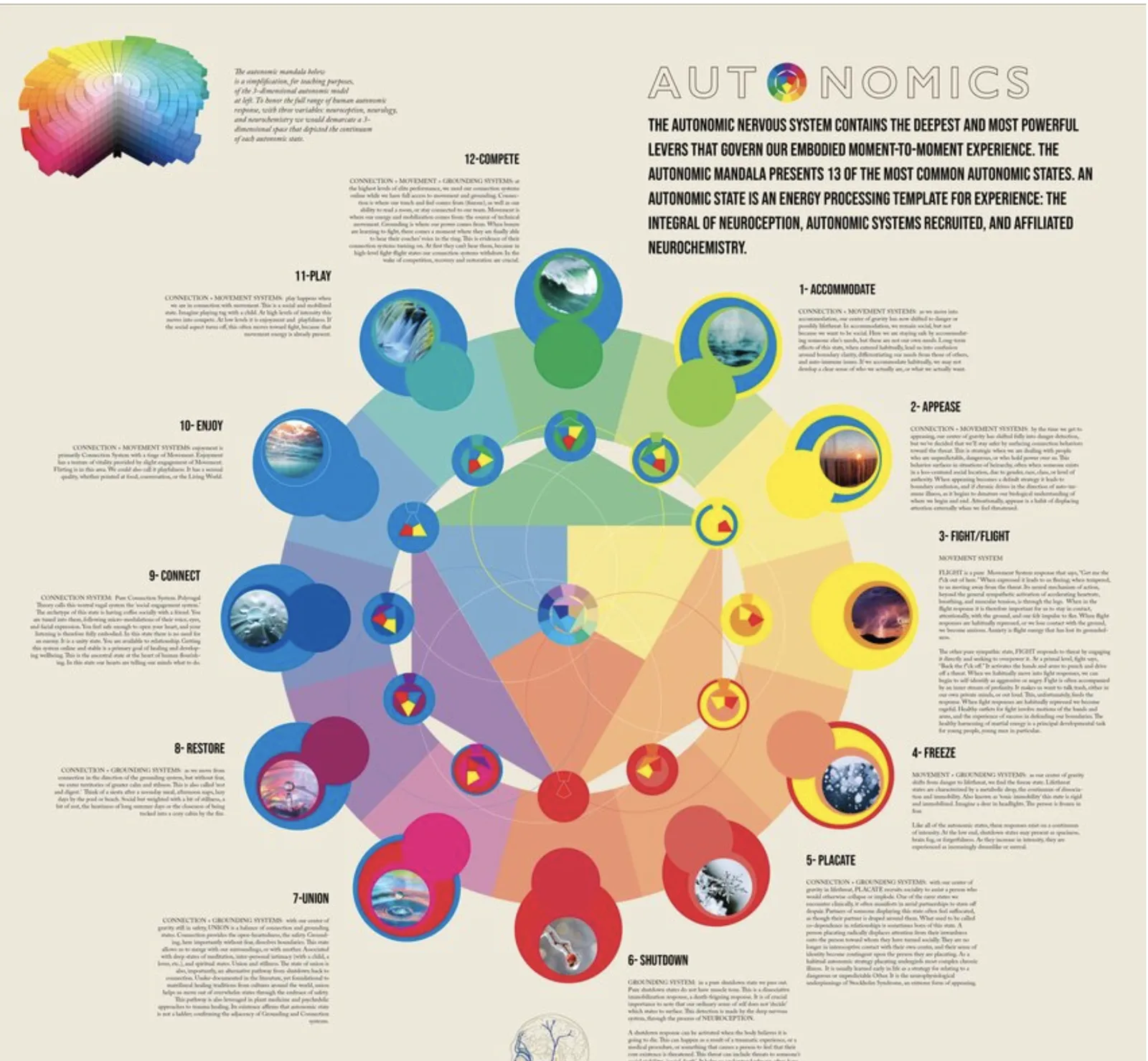
September 2025 · Poster, prepared for the International Society for Autonomic Neuroscience Symposium 2026
Autonomics Poster: Foundation Model
Visual representation of the foundation model. For those who prefer to see the architecture before reading the argument.
THE FOUNDATION
Built from primary observation.
The Autonomics model was not derived from existing literature. It was built from direct clinical observation, cross-cultural validation, and a crowdsourced dataset assembled specifically to avoid the sampling biases that have shaped Western autonomic science.
This is not a revision of existing theory. Part of our research program is ground-clearing work the field has deferred. The Autonomics framework identifies four compounding sources of structural error in foundational autonomic neuroanatomy — and builds from entirely different epistemic ground. It traces how a long-standing brain-centric bias has fundamentally misconfigured the field’s understanding of human neurology. These are not minor corrections. Removing that bias transforms what the living system is understood to be and how it is understood to function. This critical work explains why prior models are inaccurate. It is the necessary precondition for everything that follows.
Our primary research objectives are aimed further forward, at advancing human flourishing. The program investigates how autonomic state is constructed in vivo; the functional and physiological coordination of the inward senses — interoception, proprioception, and the vestibular sense — and their integration with the autonomic systems; embryonic and perinatal autonomic neurodevelopment and how the human organism establishes functional autonomic baselines; what optimal neurodevelopment looks like and how disruptions to it propagate across a lifespan; the pattern language of salutogenic and pathogenic states and how they undergird both wellbeing and disease etiology; and how to intervene successfully in autonomic and physiological conditions — including those that have been misclassified as psychological in origin.
Peer-reviewed submission is in progress.
FOR WORKING CLINICIANS
Train in the science. Transform your practice.
Start with a structured breakdown of our paper Breaking the Stasis in the Polyvagal Controversy for working clinicians.