FOR PRACTICUM ALUMNI
The Postgraduate Year
A supervision-based year for yearlong practicum graduates working toward certification. Not a repeat of the curriculum. Not a parallel track. Its sole function is to bring practitioners who completed the practicum, but did not certify, to certification-level competence.
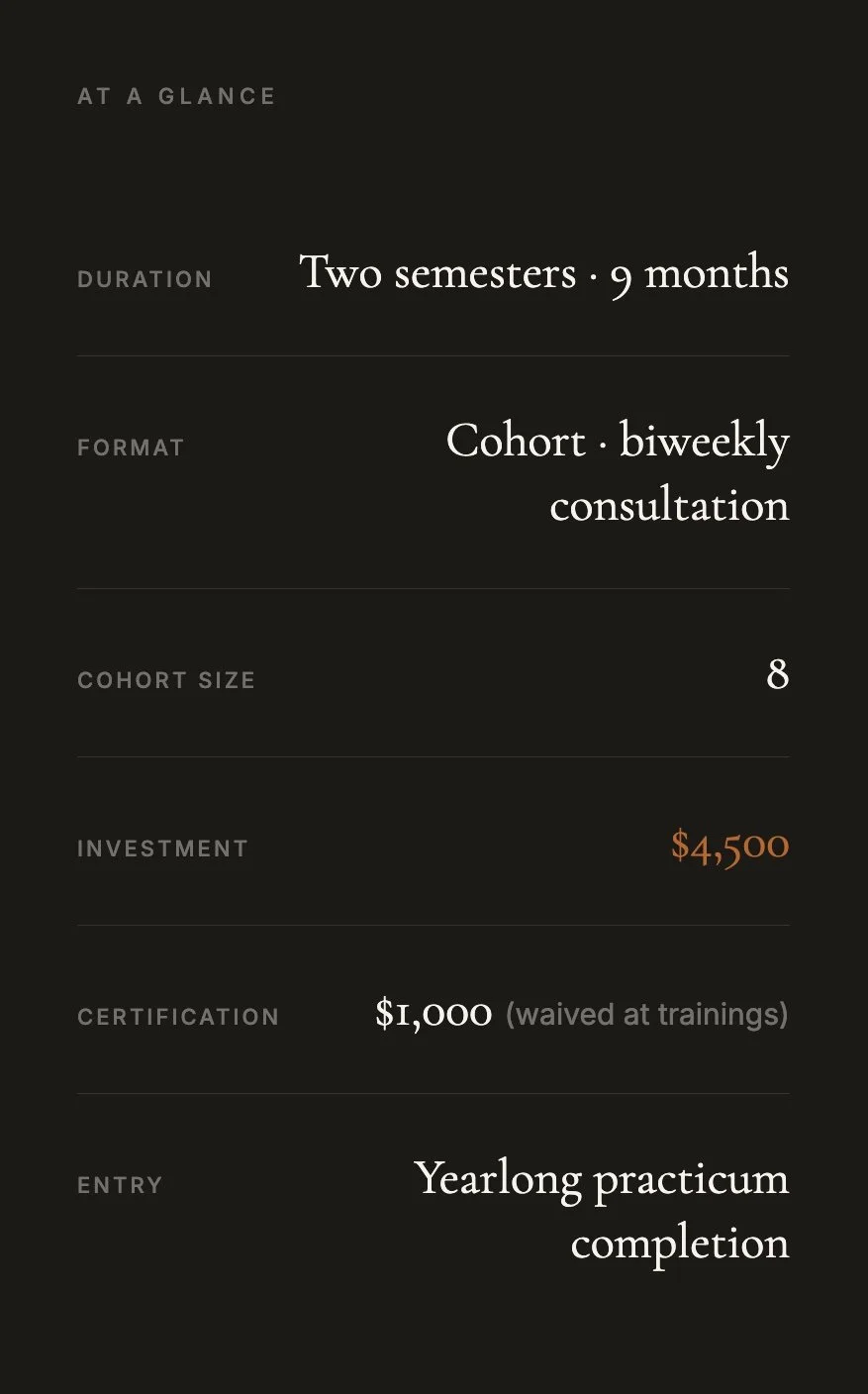
The yearlong practicum was originally designed as a two-year program. It was shortened to one year because most participants could not commit to a second year of curriculum delivery. Retention improved, but one year is not, on its own, sufficient for most participants to reach full clinical competency given the complexity of the practice domain and the self-transformation required to do this work at a high level.
The postgraduate year is the answer to that gap — reconstituted not as more curriculum, but as supervision embedded directly in a participant's ongoing practice and reflection. It asks for a different kind of time commitment: lower density, built around the cases you are already working, rather than more instruction to sit through. It pivots through case selection designed to ensure that you receive training across categories of autonomic intervention that you are likely to encounter with regularity. It encourages continued internal development, self-reflection, and community building in support of your own ANS stability and regulation.
This year is for practitioners who are already practicing, or preparing to practice, the work with clients — and wishing to hone their skills further. This is not a track for those who may never seek certification.
PURPOSE
Why this year exists
WHAT THIS YEAR DEVELOPS
Four competencies, two targets
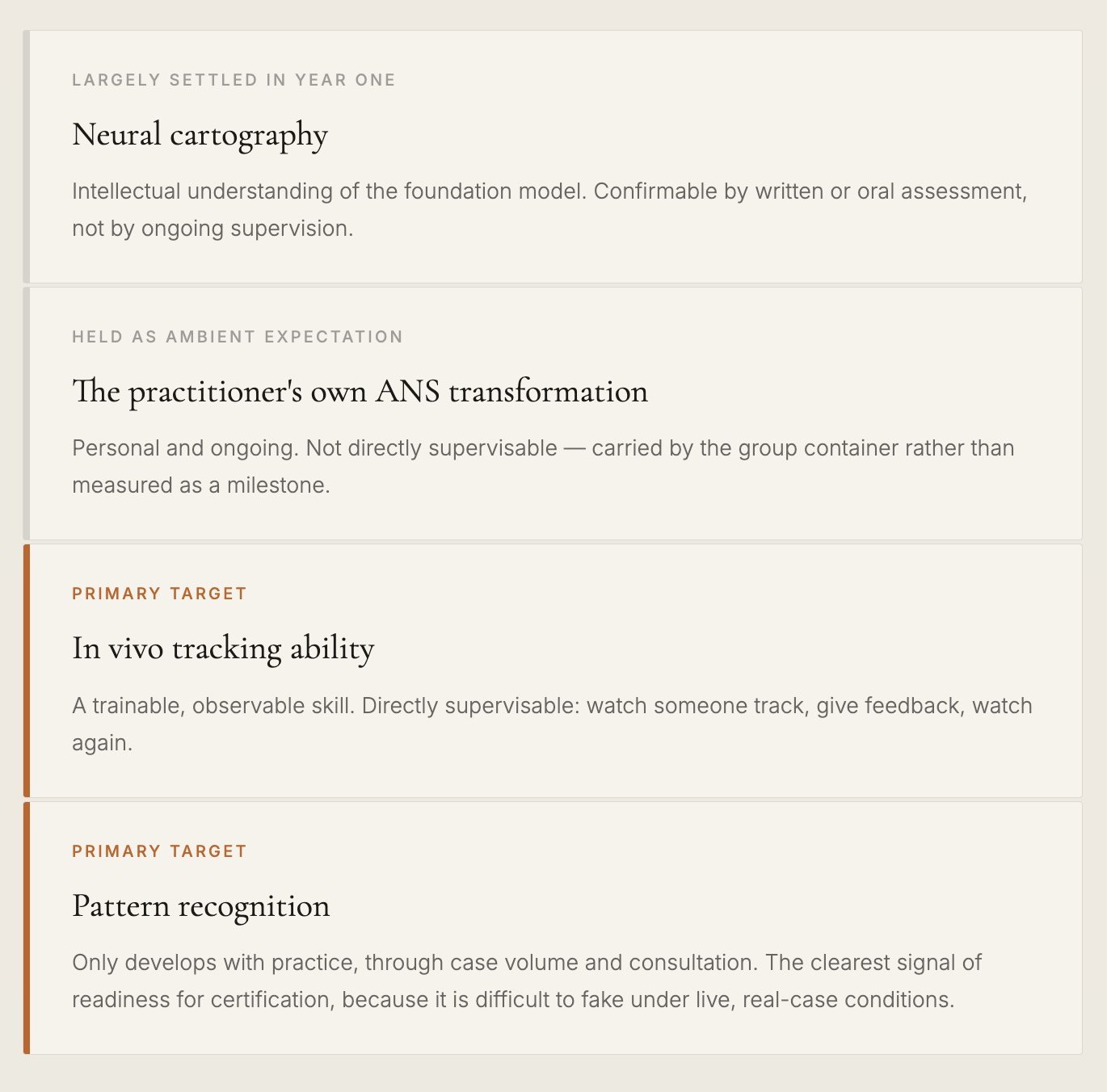
Efficacy in this work rests on four competencies. The postgraduate year focalizes the two primary clinical skill areas that are unlikely to fully develop in the yearlong practicum. →
The program borrows its structure from supervision-toward-licensure models — pre-licensure supervised practice, case consultation, and defined competency milestones — rather than a new pedagogical form.
Group case consultation is the primary container: small enough for depth per case, large enough for case variety.
Individual review happens at defined intervals, not as continuous supervision — bounded and predictable for everyone.
Certification is a judgment against observable behavior in tracking ability and pattern recognition — not a graduation for time served.
PEDAGOGICAL MODEL
Supervision towards certification
STRUCTURE
Cadence
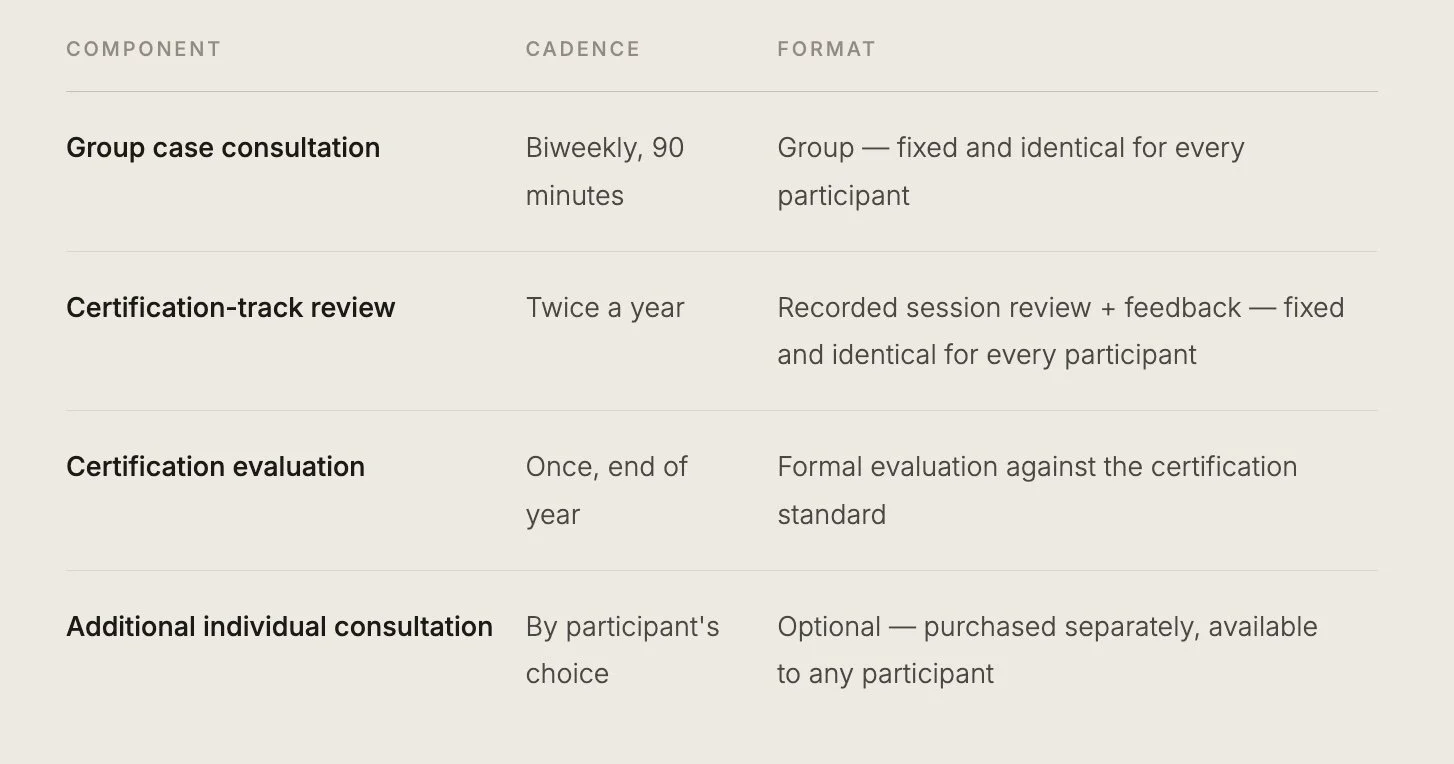

WHY GROUP CADENCE STAYS FIXED
Group case consultation is the credentialing container. Keeping it identical for every participant — regardless of what else they choose to engage — protects the integrity of certification. No participant has greater access to the process that determines readiness than any other. For participants who desire additional supervisory time from our team, this can be purchased as an add-on, depending on our clinical availability.
CERTIFICATION
Why Certify?
Certification is objective third-party validation of your autonomic cartography, tracking, and pattern recognition skills. It is a validation signal from the organization that developed this model.
Autonomic tracking skills are objectively measurable. Certification is an attestation of quality from the organization that developed the model.
Certification requires competence across autonomic domains— in clinical presentation, you are likely to see a variety of autonomic presentations: high-energy states, combined states, shutdown responses of various types. Certification ensures competence across these clinical domains.
Client assurance– certification signals to your clients that the organization that developed this work asserts your competence as a practitioner.
Referral opportunities– as Autonomics grows as a field, the requests for intervention are exceeding our clinical capacity. Certified Autonomics practitioners are the people to whom we refer clients we do not have capacity to treat.
The Path to Certifying
Eligibility to attempt certification requires completion of the required supervision within the postgraduate year. Certification is not available by attending a training alone — the supervision year is the gate.
Once required supervision is complete, certification can be attempted two ways:
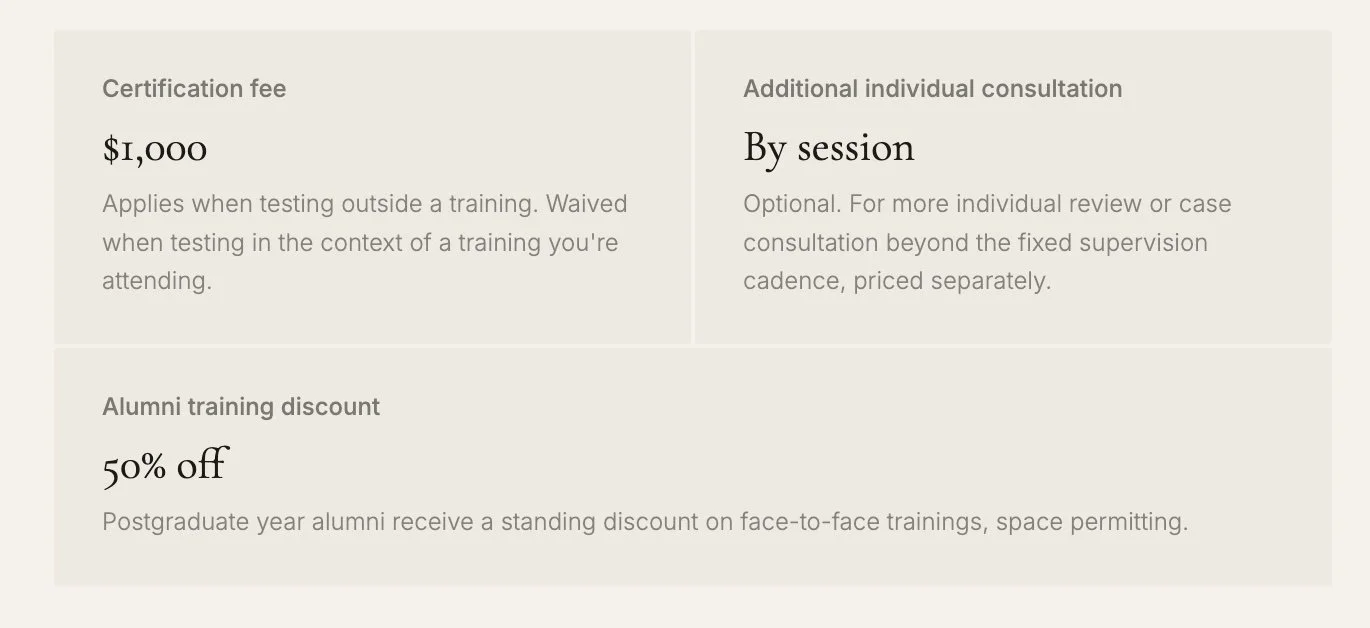
In the context of a training you're already attending— (e.g., you join us for a face-to-face training, letting us know in advance that you would like to test for certification)– no additional fee.
Outside a training— a $1,000 certification fee applies if we do the testing outside of a training circumstance.
INVESTMENT
Pricing
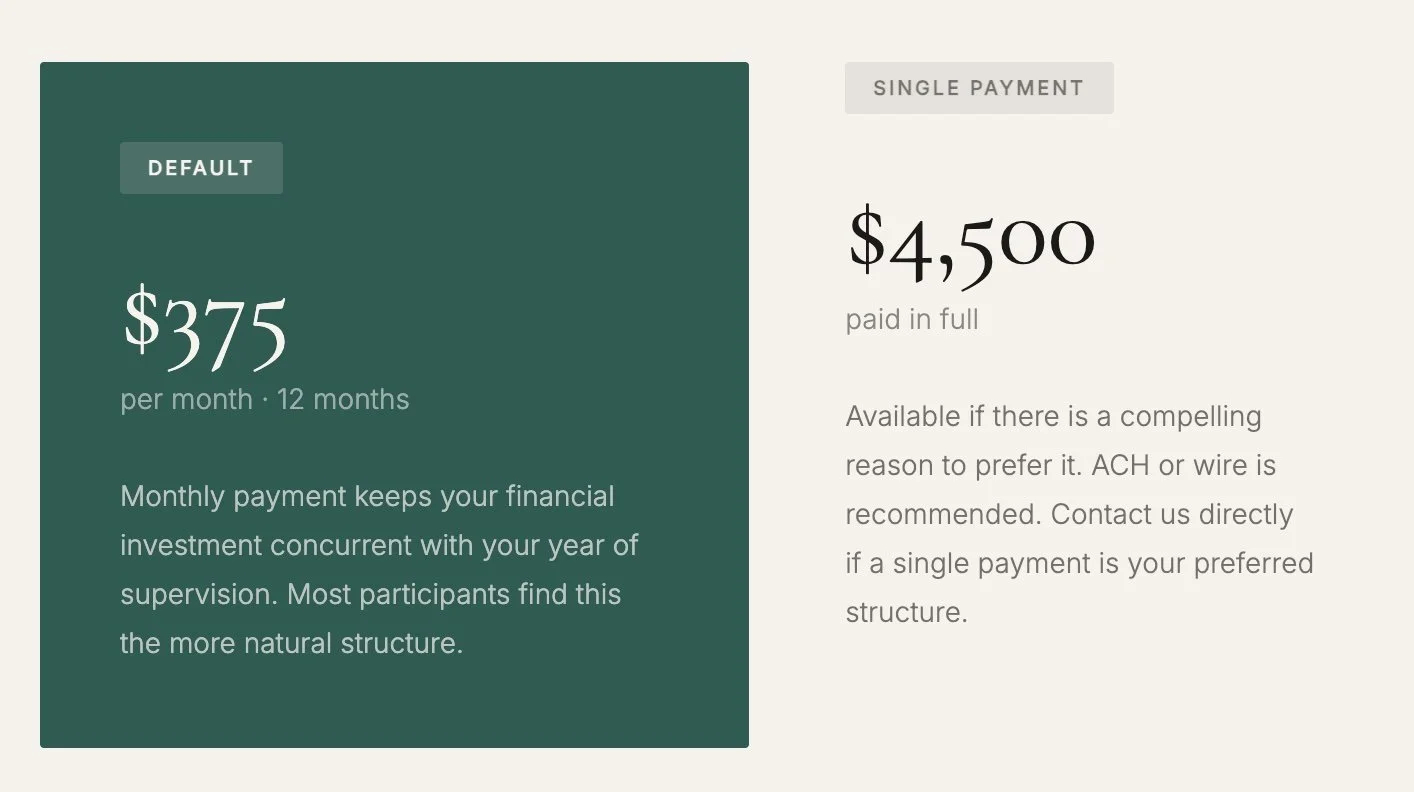
Monthly payment is the default. It is structured to keep your financial investment concurrent with your learning. Lump sum payment is available if there is a compelling reason to prefer it.